Sunday, July 17, 2016

Conan and the Dweller, Part 3 by Bobby Derie

We hear nothing from Howard about Lumley for some time, though this is to be understood as they only shared the venue of The Fantasy Fan. Howard and Lumley seem not to have written directly to one another, Howard’s correspondence with Clark Ashton Smith was sporadic and marked by long gaps, and Lovecraft’s scarce mentions Lumley at all in his letters to Howard.

Late in 1935, Lovecraft broke his rule against collaboration to revise and rewrite a manuscript by William Lumley. The story that resulted was “The Diary of Alonzo Typer,” which Lovecraft hoped to sell to Farnsworth Wright of Weird Tales or William Crawford of Marvel Tales. (OFF 296, 299; ES 2.711-2, 719) The story was accepted by Wright, with Lovecraft sending his congratulations:
Just received yours of the 12th telling of Alonzo’s (The Diary of Alonzo Typer) acceptance. Congratulations!! Your reply to Wright’s letter seems to me exactly right. I suppose he was curious about getting stories from several authors—Heald, de Castro, Reed, &c (besides parts of mss. From Barlow, Bloch, Rimel, &c)—which contained earmarks of my style. I have no objection at all to Wright’s knowing of my share in polishing off the MS. And I think that what you said was admirable. (SL5.207)
Lovecraft insisted Lumley accept full payment ($70) for the story; and considering the nearly illiterate state of Lumley’s draft (published in Crypt #10, 1982), this was true philanthropy. (HPLE 68) In gratitude, Lumley sent Lovecraft a copy of E. Wallis Budge’s translation of the Egyptian Book of the Dead. (OFF 301, 308; SL5.208) However, for whatever reason the story was not actually published in Weird Tales until February 1938, long after both Howard and Lovecraft were dead—and credited solely to Lumley. E. Hoffmann Price, on reading the story, immediately detected Lovecraft’s hand in it, and wrote a letter to the Eyrie affirming as much, and adding:
If William Lumley wrote that yarn without consultation with HPL, he has succeeded in a feat I had deemed utterly impossibly: writing a story that is more like Lovecraft than Lovecraft himself! Whatever its history, I was glad to see it in print. The references to Shamballah reminded me of many a letter HPL and I exchanged, and of our own collaboration, a few years ago. Now here is a challenge to one or more of Lovecraft’s followers: The Old Master had pondered, for some time before his death, on this matter of a weird story whose locale was to be the Valley of Teotihuacan—‘the dwelling of the gods’—in the now bleak and desolate expanse of country somewhat north of Lake Texcoco, nearly forty minutes’ drive from Mexico City. I had sent HPL photos, data, personal impressions and reactions to the pyramids and crypts of the valley. We had even planned, whimsically of course, to have Robert E. Howard join us in one expedition to Teotihuacan: I to be chauffeur, R. E. H. swordsman and gunner, and HPL to be necromancer for the party. And whenever I see their names it reminds me of a plan that was really not impossible, up until that tragic day in June of 1936 when R. E. H. went on an exploration unaccompanied by any of his friends. This whole issue, I might say, reminds me of the dead that have no equals among the survivors: Lovecraft, Howard, Whitehead. Like the Valley of Teotihuacan, the February issue is a memento of dead giants. Well, what valiant acolyte of HPL will fictionalize the mysterious Valley of Teotihuacan? Me, I am not equal to the task [...] (WT Apr 1938)

Works Cited


AMtF       A Means to Freedom (Hippocampus Press, 2 vols.)
CL            Collected Letters of Robert E. Howard (Robert E. Howard                                                Foundation, 3 vols. + Index and Addenda)
ES            Essential Solitude (Hippocampus Press, 2 vols.)
HPLE       The H. P. Lovecraft Encyclopedia (Hippocampus Press)
LRBO      Letters to Robert Bloch and Others (Hippocampus Press)
MTS        Mysteries of Time and Spirit (Night Shade Books)
OFF         O Fortunate Floridian (University of Tampa Press)
SL            Selected Letters of H. P. Lovecraft (Arkham House, 5 vols.)
SLCAS    Selected Letters of Clark Ashton Smith (Arkham House)
TFF         The Fantasy Fan (Lance Thingmaker)
UL           H. P. Lovecraft: Uncollected Letters (Necronomicon Press)

Part 1, Part 2

Sunday, July 10, 2016

Conan and the Dweller, Part 2 by Bobby Derie

By 1933, William Lumley was a fixture among Lovecraft’s correspondents, and on the circulation list for manuscripts (SLCAS 226; MTS 364, 372; OFF 205) Few other details were forthcoming, that Lovecraft expanded on Lumley’s claims, saying that the aged mystic claimed to see ghosts and “Talks sometimes of being persecuted by enemies” (LRBO 55), as well to have:
[W]itnessed monstrous rites in deserted cities, has slept in pre-human ruins and awaked 20 years older, has seen strange elemental spirits in all lands (including Buffalo, N. Y.—where he frequently visits a haunted valley and sees a white, misty Presence), has written and collaborated on powerful dramas, has conversed with incredibly wise and monstrously ancient wizards in remote Asiatic fastnesses [...] His own sorceries, I judge, are of a somewhat modest kind; though he has had very strange and marvelous results from clay images and from certain cryptical incantations. (SL4.270-1)
Clark Ashton Smith
With regard to the various and interlocking myth-cycles of Robert E. Howard, Clark Ashton Smith, Lovecraft et al., the Gent from Providence assured Smith in one letter:
He is firmly convinced that all our gang—you, Two-Gun Bob, Sony Belknap, Grandpa E’ch-Pi-El, and the rest—are genuine agents of unseen Powers in distributing hints too dark and profound for human conception or comprehension. We may think we’re writing fiction, and may even (absurd thought!) disbelieve what we write, but at bottom we are telling the truth in spite of ourselves—serving unwittingly as mouthpieces of Tsathoggua, Crom, Cthulhu, and other pleasant Outside gentry. Indeed—Bill tells me that he has fully identified my Cthulhu and Nyarlathotep ……. So that he can tell me more about ‘em that I know myself. With a little encouragement, good old Bill would unfold limitless chronicles from beyond the border—but I liked the old boy so well that I never make fun of him. (SL4.270-271)
In this belief, Lumley was several decades ahead of the occultist Kenneth Grant, who made the hidden occult reality of the Mythos crafted by Lovecraft & co. a crucial part of his Typhonian Trilogies, beginning with Dreaming Out of Space (1971) and The Magical Revival (1972).

At this point in 1933, Lumley was corresponding with both Lovecraft and Clark Ashton Smith—as was Robert E. Howard. As a consequence, Howard began to hear of Lumley from both men. While none of Smith’s letters to Howard survive, from references in Howard’s letters to Smith we know they spoke of Lumley, who is presumably “the correspondent who maintains that reptile-men once existed.” (CL3.137) In a November 1933 letter to Lovecraft, Smith wrote of Lumley: “The idea of a primeval serpent-race seems to be a favourite one with him, since he refers to it in his last letter as well as in one or two previous epistles.” (SLCAS 236)

WT Oct. 1934
Likely the reference to serpent-men arose because Smith was at that point working on “The Seven Geases” (WT Oct 1934), which contains a section referring to a race of Serpent-Men, or else perhaps because he made comment or reference to Howard’s own serpent-folk in “The Shadow Kingdom” (WT Aug 1929). There is an outside possibility that Lumley was familiar with Maurice Doreal (sometimes given as Morris Doreal, real name apparently Claude Doggins), the founder of the Brotherhood of the White Temple. Doreal’s poem “The Emerald Tablets of Thoth the Atlantean” appeared in mimeographed form in the 1930s, and describes the secret history of a shape-changing Serpent Race which have strong parallels to Howard’s story “The Shadow Kingdom.” Another reference to Lumley from Smith’s letters to Howard mentions a “seven-headed goddess of hate,” which intrigued the Texan. (CL3.151)

The story William Lumley was working on, “The City of Dim Faces” was never published—possibly never completed—but Lovecraft continued to encourage Lumley’s creative efforts, telling Robert Bloch: “Probably has a strong latent literary gift—thwarted by ignorance. Some of his weird verses are really good—even if misspelt & mis-capitalised.” (LRBO 55) Lumley had better luck with his verses, which were published in issues of The Fantasy Fan, alongside the work of Howard, Lovecraft, Smith, Derleth and others.

The Fantasy Fan Feb. 1934
“The Dweller” (“Dread and potent broods a Dweller”) appeared in the February 1934 issue The Fantasy Fan, which Lovecraft described to editor Charles D. Hornig as “haunting and excellent” (UL 13), Fantasy Fan regulars Bob Tucker and Duane W. Rimel described it as “a masterpiece” and “certainly have a touch of the bizarre that grips one,” (TFF 97, 114) and Clark Ashton Smith as “a fine thing” (SLCAS 250). Robert E. Howard wrote to Smith:
I read Lumley’s “Dweller” in the Fantasy Fan and liked it very much; it certainly reflects a depth of profound imagination seldom encountered. I hope the Fan will use more of his verse. (CL3.197)
Howard repeated the sentiment in a letter to the Fantasy Fan in a subsequent letter (CL3.203). Hornig obliged with Lumley’s “Shadows” (“There’s a city wrought of shadows”) in the May 1934 number. Clark Ashton Smith wrote to the Fantasy Fan:
I wish to commend Mr. Lumley’s remarkable poem, ‘Shadows,’ in the May TFF. The poem seems to have in it all the mystic immemorial anguish and melancholy of China. (TFF 162)
Apparently, Lumley at some point lost a statue of the Hindu god Ganesha, and Lovecraft endeavored to help replace it. (SLCAS 253) The solution came in the form of Lovecraft’s young friend and correspondent R. H. Barlow, who had recently begun doing some amateur sculpting (including a bas-relief of Cthulhu), who endeavored to make an image of Ganesha for Lumley. (ES 2.636, SL4.411, SLCAS 259, AMtF 2.801; cf. TFF 164) Lumley also received a Cthulhu print that Barlow had made. (OFF 153)

Lumley’s success at publication in the Fantasy Fan was due largely to Lovecraft’s editing of his verses, which the man from Providence freely admitted to Barlow:
Incidentally—old Bill Lumley is getting ahead of me …. Sending more verse than I can possibly attend to. Unless he can find one or more supplementary “angels” I fear his reputation—either for fecundity or for quality—is going to encounter a downward curve! (OFF 180)
Lumley’s final verse publication was “The Elder Thing” (“Oh, have you seen the Elder Thing”) in January 1935—an issue he shared with Robert E. Howard’s “Voices of the Night 2. Babel” (“Now in the gloom the pulsing drums repeat”). This was the penultimate issue of The Fantasy Fan, and though Lovecraft recommended Lumley to Donald Wollheim of The Phantagraph (which would later publish Howard’s The Hyborian Age), nothing came of it. (LRBO 313)

Works Cited


AMtF       A Means to Freedom (Hippocampus Press, 2 vols.)
CL            Collected Letters of Robert E. Howard (Robert E. Howard                                                Foundation, 3 vols. + Index and Addenda)
ES            Essential Solitude (Hippocampus Press, 2 vols.)
HPLE       The H. P. Lovecraft Encyclopedia (Hippocampus Press)
LRBO      Letters to Robert Bloch and Others (Hippocampus Press)
MTS        Mysteries of Time and Spirit (Night Shade Books)
OFF         O Fortunate Floridian (University of Tampa Press)
SL            Selected Letters of H. P. Lovecraft (Arkham House, 5 vols.)
SLCAS    Selected Letters of Clark Ashton Smith (Arkham House)
TFF         The Fantasy Fan (Lance Thingmaker)
UL           H. P. Lovecraft: Uncollected Letters (Necronomicon Press)

Part 1, Part 3


Sunday, July 3, 2016

Conan and the Dweller, Part 1 by Bobby Derie

The idea of a land of darkness is excellent, and one footnote telling of ancient MSS. Which even the Egyptian priests could not read excited my imagination tremendously. That kind of thing resembles my own (purely mythical) “Pnakotic Manuscripts”; which are supposed to be the work of “Elder Ones” preceding the human race on this planet, and handed down through an early human civilization which once existed around the north pole.—H. P. Lovecraft to William Lumley, 12 May 1931, SL3.372-3

Farnsworth Wright
     A few months before Farnsworth Wright forwarded a letter from Robert E.Weird Tales put Lovecraft in touch with another fan: William Lumley (1880-1960) of Buffalo, New York, a watchman for the Agrico Chemical Company. (HPLE 159) According to Lovecraft, Lumley was a firm believer in the occult, having studied Albertus Magnus (Grand Albert and Petit Albert), Cornelius Agrippa (De Occulta Philosophia libri tres), Hermes Trismegistus (Corpus Hermeticum), Martin Delrio (Disquisitionum Magicarum Libri Sex), Paracelsus (probably the Archidoxes of Magic), and Remigius (Nicholas Rémy, Daemonolatreiae libri tres); references to Appolonius of Tyana, Geber, and Pythagorus were likely taken from Éliphas Lévi’s History of Magic—although Lovecraft goes on to add “Eibon, von Junzt , and Abdul Alhazred,” so HPL could have been exaggerating for effect, drawing on his own reading in the history of medieval grimoires. Like Howard and many of Lovecraft’s others correspondents, Lumley inquired into the reality of Cthulhu, Yog-Sothoth, and the rest of the artificial mythology. (AMtF 1.287-8, ES 1.339, SL4.270-1)

     Lumley and Lovecraft’s correspondence developed in parallel with Lovecraft and Howard’s. The Buffalo occultist was grateful enough to Lovecraft to gift him a copy of William Bradford’s Vathek in 1931 (ES 1.339) and Edward Lucas White’s Lukundoo & Other Stories in 1933 (LRBO 32), and Lovecraft in return planned to send Lumley a copy of an occult catalogue (ES 1.345). Despite being described by Lovecraft as “semi-illiterate” and “very crude in some ways,” he also claimed Lumley was “amazingly erudite in the lore of mediaeval magic, & possessed of a keen & genuine sense of the fantastic” (ES 1.448-9), “& with a streak of genuine weird sensitiveness not very far removed from a certain sort of blind, rhapsodic genius.” (ES 2.486)


H.P. Lovecraft
Lovecraft continued to answer his letters, including Lumley in his regular circle of correspondence. In a letter dated 7 May 1932, Lovecraft first describes Lumley to Robert E. Howard:
He claims to have traveled to all the secret places of the world—India, China, Nepal, Egypt, Thibet, etc.—and to have picked up all sorts of forbidden elder lore; also to have read Paracelsus, Remigius, Cornelius Agrippa, and all the other esoteric authors whom most of us merely talk about and refer to as we do to the Necronomicon and Black Book. He believes in occult mysteries, and is always telling about “manifestations” he sees in haunted houses and shunned valleys. He also speaks often of a mysterious friend of his—“The Oriental Ancient”—who is going to get him a forbidden book (as a loan, and not to be touched without certain ceremonies of mystical purification) from some hidden and unnamed monastery in India. Lumley is semi-illiterate—with no command of spelling or capitalisation—yet has a marvelously active and poetic imagination. He is going to write a story called “The City of Dim Faces”, and from what he says of it I honestly believe it will be excellent in a strange, mystical, atmospheric way. The fellow has a remarkable sort of natural eloquence—a chanting, imageful style which almost triumphs over its illiteracies. If he finishes this tale I think I’ll help him knock it into shape for submission to Wright. There is real charm—as well as real pathos—about this wistful old boy, who seems to be well long in years and in rather uncertain health. He obviously has a higher-grade mind than Olson could ever have had—for even now there is a certain wild beauty and consistency, with not the least touch of incoherence, in his epistolary extravagances. Young Brobst (as I told you, nurse in a mental hospital) thinks a touch of real insanity is present, but I regard the case as a borderline one. I always answer his letters in as kindly a fashion as possible. (AMtF 1.287-8; cf. ES 1.448-9)
Henry S. Whitehead
     The “Olson” in question is another semi-literate Weird Tales fan that believed in the occult, but in contrast to Lovecraft’s description of Lumley as a “good old soul,” Olson wrote harassing, nonsensical letters to Henry S. Whitehead, Clark Ashton Smith, and Robert E. Howard. (ES 339) Lumley apparently received the book from the “Oriental ancient” which was “not to be touched without certain ceremonies of mystical purification” is reflective of the European grimoire tradition with works like the Lesser Key of Solomon or the Book of the Sacred Magic of Abra-Melin the Mage; in a letter to Clark Ashton Smith, Lovecraft expanded that these ceremonies included “the donning of a white robe,” which is characteristic for purification rituals in both works. (SL4.270)

     The Texan was intrigued enough by Lovecraft’s description to inquire further about Lumley in his answering letter:
I was much interested in what you said of the man Lumley, of Buffalo. He must be indeed an interesting study; possibly of such a sensitive and delicate nature that he has, more or less unconsciously, taken refuge from reality in misty imaginings and occult dreams. I hope he completes his story, and that it is published. Do you believe the “Oriental Ancient” has any existence outside his imagination? There is to me a terrible pathos in a man’s vain wanderings on occult paths, and clutching at non-existent things, as a refuge from the soul-crushing stark realities of life. (AMtF 1.292, CL2.354)
     Howard’s sentiment echoes the theme of his King Kull story “The Mirrors of Tuzun Thune” (WT Sep 1929), but he found it interesting enough to pass along an abridged version of Lovecraft’s account to Tevis Clyde Smith:
Lovecraft tells me about an old fellow who writes him all sorts of phantasies about esoteric subjects, and relates spectral manifestations glimpsed in haunted houses and the like; he professes to have pried into all the mysterious corners of the world, and to be hand-in-glove with a cryptic being he calls “the Oriental ancient” who apparently bobs up unexpectedly from behind sofas and well-curbs, gives vent to philosophic gems and utterances, and vanishes again. Lovecraft thinks the old gentleman is on the border-line of sanity, but one Brobst, a brain student, thinks he is nuts. (CL2.369)

Robert E. Howard
Lovecraft replied to Howard at length:
This fellow Lumley, on the other hand, is a really fascinating character—in a way, a sort of thwarted poet. It is very hard to tell where his sense of fact begins to give way to imaginative embroidery—but I think he usually enlarges on some actual nucleus. He has, I imagine, really knocked about the world quite a bit—hence his dreams of visiting Nepal, darkest Africa, the interior of China, and so on. I fancy there is some old fellow corresponding to his idealised figure of “The Oriental Ancient”—perhaps an aged and talkative Chinese laundryman, or perhaps even some “Swami” of the sort now found in increasing numbers wherever the field for faddist-cult organisation seems promising. Providence, for example, has several of these swarthy Eastern ascetics nowadays. Lumley is naturally in touch with all sorts of freak cults from Rosicrucians to Theosophists. I surely hope he will finish his “City of Dim Faces”, for anything written uncommercially—from the pure self-expression motive—is a welcome rarity nowadays. There is surely, as you say, a tremendous pathos in the case of those who clutch at unreality as a compensation for inadequate or uncongenial realities. (AMtF 1.307)
     Lovecraft and Howard were both generally unversed in the details of the occult, though each worked to expand their knowledge through reading and correspondence, aided in part by a collection of materials on theosophy supplied by E. Hoffmann Price and circulated among the group. The influence of theosophy in particular on both authors has been examined in essays like HPL and HPB: Lovecraft’s Use of Theosophy by Robert M. Price and Theosophy and the Thurian Age by Jeffrey Shanks.

Works Cited

AMtF       A Means to Freedom (Hippocampus Press, 2 vols.)
CL            Collected Letters of Robert E. Howard (Robert E. Howard                                                Foundation, 3 vols. + Index and Addenda)
ES            Essential Solitude (Hippocampus Press, 2 vols.)
HPLE       The H. P. Lovecraft Encyclopedia (Hippocampus Press)
LRBO      Letters to Robert Bloch and Others (Hippocampus Press)
MTS        Mysteries of Time and Spirit (Night Shade Books)
OFF         O Fortunate Floridian (University of Tampa Press)
SL            Selected Letters of H. P. Lovecraft (Arkham House, 5 vols.)
SLCAS    Selected Letters of Clark Ashton Smith (Arkham House)
TFF         The Fantasy Fan (Lance Thingmaker)
UL           H. P. Lovecraft: Uncollected Letters (Necronomicon Press)


Sunday, June 26, 2016

The Robert E. Howard Foundation Awards & Other Announcements

Every year, the board of directors chooses articles, artwork/artists, and other people/projects as nominees for their Foundation Awards. These people & projects are nominated due to their efforts at furthering Robert E. Howard and his works in academia and popular culture. There are eleven nomination categories:
  1. The Atlantean—Outstanding Achievement, Book (non-anthology/collection)
  2. The Valusian—Outstanding Achievement, Book (anthology/collection)
  3. The Hyrkanian—Outstanding Achievement, Essay (Print)
  4. The Cimmerian—Outstanding Achievement, Essay (Online)
  5. The Venarium—Emerging Scholar
  6. The Stygian—Outstanding Achievement, Website
  7. The Aquilonian—Outstanding Achievement, Periodical
  8. The Black Lotus—Outstanding Achievement, Multimedia
  9. The Black River—Special Achievement
  10. The Rankin—Artistic achievement in the depiction of REH’s life and/or work
  11. Black Circle Award—Lifetime Achievement
This year, many of the above categories included people/articles from this very website (On An Underwood No. 5). In fact, On An Underwood No. 5 was nominated for The Stygian and made it to the final voting stage but was ultimately beat by the ever popular and long standing website: REH: Two-Gun Raconteur. There is always next year!

Two nominees were for actual articles/series from this website:

DAVID PISKE – “Barbarism and Civilization in the Letters of Robert E. Howard and H.P. Lovecraft: A Summary with Commentary (6 parts).”

BOBBY DERIE – “The Mirror of E’ch-Pi-El: Robert E. Howard in the Letters of H.P. Lovecraft (3 parts).”

And, several of the writers/scholars who were nominated (some also won) contributed to On An Underwood No. 5. These were:

BOBBY DERIE – Contributed essays to TGR blog, On An Underwood No. 5, and compiled the The Collected Letters of REH: Index and Addenda

TODD VICK — Contributed essays to TGR and On An Underwood No. 5; Editor of On An Underwood No. 5 blog

DAMON SASSER — Awarded for his journal and Blog - REH: Two-Gun Racontuer, also contributed an essay last year (2015) to On An Underwood No. 5

ROB ROEHM — For his biographical research published at the REH: Two-Gun Raconteur Blog, On an Underwood No. 5, and the Black Gate website.

One other first round nominee was for David Bowles who wrote an excellent article for this blog titled, "Toltec Traces in “The Thunder-Rider." Also, award winner Barbara Barrett contributed several articles here at On An Underwood No. 5: The Game's Afoot! & An Overview of Robert E. Howard's Poem: "The Ballad of King Geraint". Barbara tied with David Piske for the The Cimmerian Award — Outstanding Achievement, Essay (Online) for her series at REH: Two-Gun Raconteur titled “Hester Jane Ervin Howard and Tuberculosis (3 parts).”

This is quite a showing from this little blog in a single year. As editor of this blog, I am quite proud to have participated in all the above. But it should be pointed out that of those listed above, two are regular contributors to On an Underwood No. 5.

The first of these is, Bobby Derie. This year Bobby won two REH Foundation awards:

Bobby Derie with his REH Foundation awards
on the REH House porch in Cross Plains, TX
The Atlantean Award — Outstanding Achievement, Book (non-anthology/collection), for his book titled The Collected Letters of REH: Index and Addenda (which I have used and am currently using for research).

And, The Venarium Award — Emerging Scholar.

It should also be noted that Bobby Derie is a well established H.P. Lovecraft scholar. And, with regard to Lovecraft studies Derie is the author of Sex and the Cthulhu Mythos. Derie has contributed a number of high quality articles here at On an Underwood No. 5 over the past year.

The second of these is, David Piske. Piske has written one of the more popular series (in terms of clicks on the series) here at On An Underwood No. 5. Not only was this Piske first year to even be nominated for an REH Foundation award, but he actually won an award:

David Piske with his REH Foundation award
at the REH house in Cross Plains, TX
The Cimmerian Award — Outstanding Achievement, Essay (Online) for his series “Barbarism and Civilization in the Letters of Robert E. Howard and H.P. Lovecraft: A Summary with Commentary.”

Piske has also written the popular trip reports for the last two Howard Days events: 2015 & 2016

Piske is also wrapping up his award winning series, "Barbarism and Civilization in the Letters of Robert E. Howard and H.P. Lovecraft: A Summary with Commentary." So, readers can expect a few final posts on that series in the near future. 

My goal for 2015 and 2016 was to raise the quality and standard of articles that appear at On An Underwood No. 5. I think I've accomplished this. I hope to be able to continue that standard in the years to come. However, I must admit that it is very time taxing and difficult to get solid writers/scholars lined up to write for the blog. I've invited at least a half-dozen other scholars/writers to contribute to On An Underwood No. 5, several have said they would when their schedules clear up or they can find the time.

In the meantime, I'll try my best to provide a few articles over the next months. However, I am currently working on a book to be published by The University of Texas Press about the last 6 years of Robert E. Howard's life. This work, of course, will keep me extremely busy. Cheers!


Friday, June 17, 2016

Robert E. Howard Days 2016: A Trip Report by David Piske


This year was my fourth year attending Robert E. Howard Days. The annual pilgrimage to Cross Plains has become a special event for me, but this year it was even more so for several reasons. For one thing, coming to Cross Plains early afforded a chance to take part in a tour that wasn't officially part of REH Days. Secondly, Howard Days experienced a couple "firsts" this year. Also, as with the last three years, I was pleased to reconnect with friends, and make several new ones. Adding to the significance of this year's celebration, 2016 marks many anniversaries related to Robert E Howard. Three in particular were observed at the celebration last week: the 50th anniversary of the publication of Conan the Adventurer from Lancer Books, the 30th anniversary of the very first Robert E. Howard Days, and the 20th anniversary of the release of the film The Whole Wide World. These were observed and celebrated through panels dedicated to each, and by the guest of honor, Michael Scott Myers, screenwriter of The Whole Wide World.

As always, I went to Cross Plains with my friend Todd Vick (editor and host of this blog). We arrived on Wednesday night. I didn't know what there would be to do in Cross Plains two days before the event, but I'm always willing for an extra day or two of vacation. To my surprise, I learned that it pays to show up before the official start of Howard Days. The Howard Home and Museum is a natural rallying point for pilgrims, and we weren't the first ones who decided to arrive early. Let the fellowship begin.

Cross Plains Review
On Thursday the Cross Plains Review held a tour of its facility. Founded in 1909, the Review is the town's longest running business, and one of Texas' oldest continuously running newspapers. Jack Baum served as our tour guide, noting an interesting connection between the paper and Robert Howard. Around 1925 Howard worked briefly for the paper, reporting oil news. And since Baum had worked extensively on the paper's printing machines as a boy, he guided us around through the process and explained the tense and often dangerous job of getting a paper to press. Antique fixtures still installed at the paper include a 1922 Linotype, several type cabinets, a guillotine-like newsprint cutter (on which several people lost fingers over the years), and the highlight: an original Babcock printing press, which is so massive it had to be set on the property's foundation before the building was even constructed. As an added bonus original copies of the Review from 1936 were displayed. Pages included obituaries of Robert's and Hester's deaths, and Robert's story, "A Man Eating Jeopard," which was published a week after his death. These come from the Southwest Collection at Texas Tech University, and were brought by Rob King, who has been working on digitizing original copies of the paper (which can be viewed here [www.collections.swco.ttu.edu]}.

Activities on Friday always start in the morning with registration at the Howard house. It's a good time to to meet up with other arriving attendees and peruse the tables at the "REH Swap Meet" under the pavilion. In a quiet moment I picked up a few new volumes for my small but growing REH library at the museum gift shop/obsession-enabler, and a bit later I got to spy two original issues of Weird Tales that Patrice Louinet was displaying (to everyone's envy).

30 Years of Howard Days
(L to R: Cavalier, McNeel Childers, & Burke)
All of the day's panels were held at Cross Plains High School; the first of these, "Thirty Years of Howard Days" took place in the school's library. Rusty Burke and Bill Cavalier told stories about their first pilgrimages to Cross Plains, and related how the annual gathering we now know came to be gradually organized. And Susan McNeel Childers of Cross Plains told stories from the hometown perspective. Similarly, during the Q/A segment, Cross Plains native and former holder of the Howard estate rights, Jack Baum, talked about the growing receptivity of the town to Howard pilgrims.


Wednesday, June 15, 2016

A Brief Word on the 80th Anniversary of Robert E. Howard's Death by Todd Vick

I was in Cross Plains, Texas this past June 11th on the 80th anniversary of Robert E. Howard's death. Along with around 400 or so people (townspeople included), we were there celebrating, not the death of Howard, but his life and works. Several people mentioned this was the 80th anniversary of the writer's death. Many of us raised a glass in his honor, read poetry he had written on his front porch, and presented panel discussions about his life and works.

I spent from Wednesday to Sunday morning in Cross Plains. I met many new faces (this was my 5th year attending the annual event), shook hands with old friends, and participated in some meaningful conversations. If you've never experienced a Howard Days in Cross Plains, TX, and you're a Robert E. Howard fan, then you are missing something quite special.

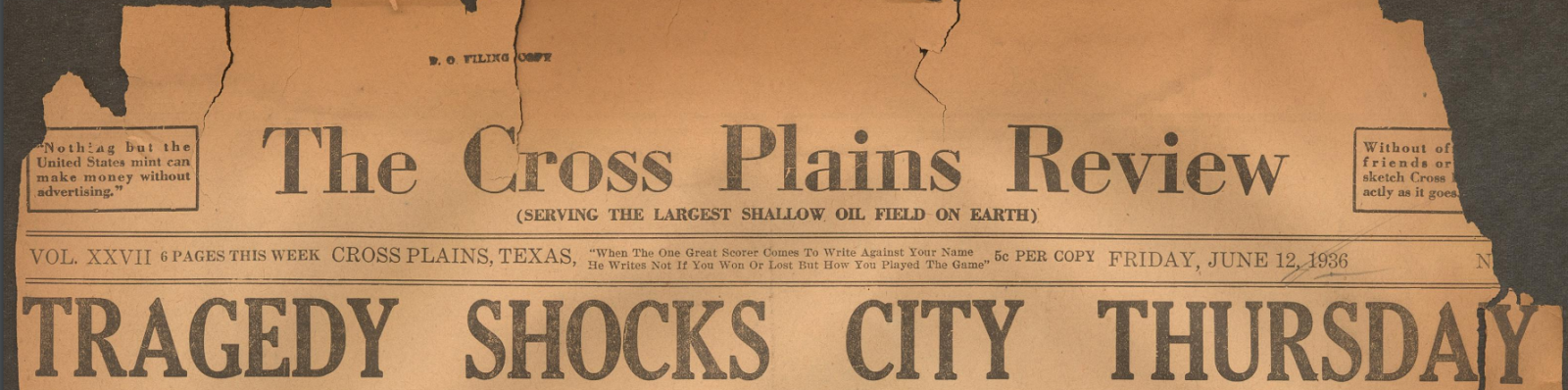
Regarding the anniversary of his death; Robert E. Howard died on a Thursday, approximately eight hours after he shot himself in the head. Below is a picture of the actual headlines the day after Robert E. Howard died, June 12th, 1936:


Below are two images of the actual story in the Cross Plains Review, June 12th, 1936 (these scans are of an actual copy of the newspaper. Parts of the right edges of the paper have been worn away from wear over time):

Part 1                                                             Part 2


To say the death of Robert E. Howard was a tragedy is certainly an understatement. He left a large gap not only in the pulp fiction world (esp. in Weird Tales) but also in the general world of fiction. Even so, his works have survived in magazines, academic journals, books, anthologies, and his characters are seen on television, the big screen, comic books, RPG and board games, as well as video games. Howard and his works have become an international phenomenon!

Robert E. Howard's impact has sent waves across the world to a variety of people from all walks of life. And just imagine, it all started in the small central West Texas town of Cross Plains, where his life and works are still celebrated.

A trip report is soon to follow. Cheers!

Todd B. Vick