Showing posts with label Comanche. Show all posts

Sunday, August 9, 2015

REH and Callahan County by Damon C. Sasser

Robert E. Howard wrote the following in a February 1933 letter to August Derleth:

Whether the history of Callahan County will ever be written is doubtful. At least, I’m far too lazy to do the work necessary, though in a way it would be easier than writing the history of Brown, since it was settled at a later date, and more sparsely. At the same time, records of early settlement are not so plentiful. If I ever write any chronicle of the County, it will deal only with the time beginning at the date on which I came here. What with oil booms and the like, its history during that time has not been tame, though undoubtedly lacking the general interest of the early frontier days.

Of course Howard could not foresee the advent of the Information Age and the invention of the Internet, which made the history of everything, including Callahan County, easily accessible to everyone. You can throw a dart at a county map of Texas and no matter which county the dart’s point hits, odds are that county is going to have a violent and storied past. Such is the case of Howard’s home county of Callahan.

Callahan County Courthouse ca 1900-1929
Callahan County was established in 1858 from parts of Bexar, Bosque, and Travis Counties. Those counties covered huge areas of Texas in the early to mid-1800s and were divided up into smaller counties, allowing locals more governmental control over the area they lived in. The new county was named for James Hughes Callahan, a survivor of the Goliad Massacre and leader of the Callahan Expedition. But hardly anyone was interested in settling this isolated region for the first eighteen years of its existence. This was due to the fact that the Comanche Indians roamed the rolling plains region of Central Texas where Callahan County is situated.

There were numerous clashes between the early settlers and the local Indian tribes and Howard recounted some of these battles in his letters. Here is a real life account of the Sipe Springs Indian incidents, as told by Miss Carrie Childress:

Captain M.W Hall organized a company of Minute Men in 1873 for protection of the settlers against the Indians. In 1873 the Indians drove off the horses of a ranching operation owned by a Mr. Justice and (Cal) Watkins on the Sabano.  A man by the name of Gass Evans notified the company and they followed the Indians into Callahan County and recovered the horses. The last Indian raid was made in 1874, when the Indians killed Bob Leslie on Rush Creek. In leaving the country they touch[ed] the point where the house now stands on the old Tom Hale place east of town and swung into the north and west. A few earlier raids had been made in the early part of January 1870, the Indians raiding the Schmick and Follis ranch, and driving off the horses; Bill McGuire, the only man on the ranch who had been left to protect the women and children shot at the Indians but they made their get-away with their horses.

The Comanches remained a threat well into the 1870’s when a contingent of troops under the command of Colonel Ranald S. Mackenzie defeated the Comanches at Palo Duro Canyon in 1874, which was to be the last battle in the Texas Indian Wars. The few remaining hostile Indians were driven away later that same year by William J. Maltby commanding Company E of the Frontier Battalion of the Texas Rangers.

After the end of the Indian wars, more and more settlers moved into the area – part of the ceaseless westward expansion. Gradually, the string of forts manned by the US Army that threaded south to north across the West Texas Plains were abandoned one after the other until the last one lowered its flag in 1891.
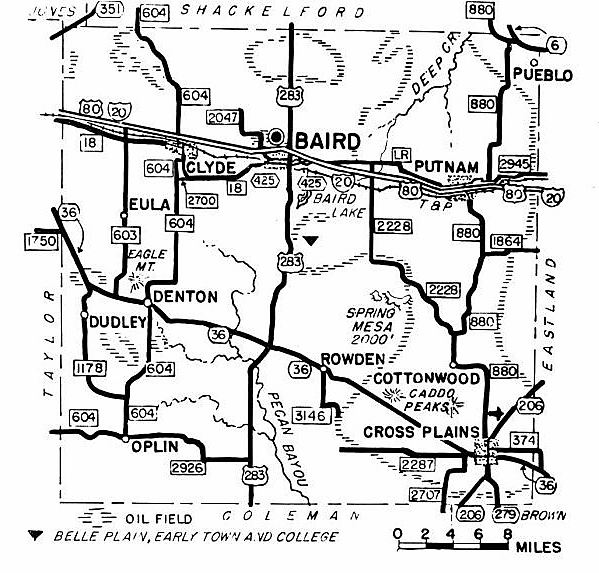
Map of Callahan County
 In 1877, the County was formally organized and the Callahan County Commissioners Court held an election in December to name the county seat. The town of Belle Plain was in the running and so was the temporary county seat, Callahan City; no doubt so named with hopes of becoming the permanent county seat. But the name advantage did little good – when the votes were counted, Callahan City lost its county seat status to Belle Plain. This sentenced Callahan City to a slow death. But as it turned out, Belle Plain only got a brief reprieve from that same fate.

Stations for the new Texas and Pacific Railway line were being built from Dallas to El Paso, with stops planned for Putnam, Baird, and Clyde – small settlements which quickly developed into towns. The railroad had completely bypassed Belle Plain six miles to the north. In January of 1883, an election resulted in Baird being made the new county seat. The effect of this outcome led to Belle Plain’s stone jail and most of the residences being moved to Baird, leaving only a handful of families in the dying town.
Texas farming ca 1890s
During period from the 1880s until the early 1900s, farming and ranching were the mainstays of the County. Corn, wheat, oats and cotton were the primary agriculture crops, while beef cattle accounted for the majority of the ranching, with some sheep being a commodity during the decade from 1880 to 1890. The population grew from 8,768 in 1900 to 12,973 in 1910. The pace of growth slowed after 1910 and started to decline by the mid-teens. The number of citizens in Callahan County fell to 11,844 by the time the Howards arrived in Cross Plains in 1919. The Texas Central Railroad had only come to Cross Plains seven years before the Howards bought a house and settled down. After the railway was built, the town became a major trading center for cotton and other crops.

The agriculture boom that Callahan County enjoyed had its price. Increased demand for land caused the price of real estate to rise. As a result of this, a lot of newcomers could not afford to buy land and this led to an increased number of tenant farmers. By 1920 nearly half the farmers (823 of 1,649) were tenants. The majority of these were sharecroppers who were permitted by landowners to farm the land and collected only a share of the harvest as payment for their efforts. While most sharecroppers in the state were African American, the reverse was true in Callahan County – all but one of the tenants was white.

Eventually, overgrazing, drought, soil erosion, and a shortage of potable water took its toll on ranching and farming in the county. This led to several conservation programs being established.

The decline in agriculture was somewhat offset by the discovery of oil in Callahan County and adjacent counties in 1923. A number of promising fields were found in Cross Plains, Pioneer, Cross Cut, and Blake, and by the late 1920s the oil business was booming bigtime. The oil and gas revenues generated from the production from the numerous wells in the area made it easier for some landowners to survive the economic slump of the 1930s and even made a few large landowners quite wealthy.

Like all Texas oil boom towns of that era, the oil fields in and around Callahan County were flooded with land speculators, oilmen, roughnecks, prospectors, panhandlers and fortune seekers. Those in turn drew in a seedier element of society, including card-sharks, prostitutes, bootleggers and drug dealers. Here, in a December 1930 letter to H.P. Lovecraft, Howard expresses his disdain for what his town and county became during the boom years:

You’re right about oil booms — they bring a lot of money into the country and take more out, as well as ruining the country for other purposes. This might offend men in the oil business, but it’s the truth that I’ve seen more young people sent to the Devil through the debauching effects of an oil boom than all the other reasons put together. I know; I was a kid in a boom town myself. The average child of ten or twelve who’s lived through a boom or so, knows more vileness and bestial sinfulness than a man of thirty should know — whether he — or she — practice what they know or not. Glamor and filth! That’s an oil boom. When I was a kid I worked in the tailoring business just as one terrific boom was dwindling out, and harlots used to give me dresses to be cleaned — sometimes they’d be in a mess from the wearer having been drunk and in the gutter. Beautiful silk and lace, delicate of texture and workmanship, but disgustingly soiled — such dresses always symbolized boom days and nights, to me — shimmering, tantalizing, alluring things, bright as dreams, but stained with nameless filth.

An oil well in Cisco ca. 1920s
Howard made other references to the ills brought about by an oil boom, but this one in particular stands out. While the county prospered when the oil was flowing, once it stopped everyone who came seeking their fortune moved on leaving the permanent residents of Callahan County to clean up the “nameless filth” they left behind.

With the onset of the Great Depression in the 1930s, many of the county's farmers, both tenants and owners experienced hard times and were heavily indebted. A combination of falling agricultural prices coupled with a boll weevil outbreak caused most banks to cease extending additional credit to the struggling farmers, forcing many of them off the land they owned or sharecropped.

By the end of 1936, the year Howard died, things were turning around for Callahan County and the rest of the nation as it slowly started climbing out of the depths of the Great Depression. While Howard had no interest in writing the history of his county, he did have a strong desire to write a great novel of his beloved Texas, a desire that went unfulfilled.


About Damon Sasser:

Damon Sasser has been a staple in Robert E. Howard fandom and REH Studies for four decades. He is the founder of REH: Two-Gun Raconteur website and journal. Sasser is a member of The Robert E. Howard United Press Association (REHupa) and has written countless articles for various fanzines and journals.

Sasser also has a nice Facebook Page for both the TGR website and journal. Be sure and check it out and "like" the page. You will not only get updates about articles posted on TGR but other tid-bits of great information on REH, H.P. Lovecraft, pulp zines, and what is circulating around the REH scholarly network.


Sunday, July 19, 2015

Toltec Traces in “The Thunder-Rider” By David Bowles

Around the same time that Robert E. Howard was writing his James Allison tales (in which a young, dying Texan remembers adventures from various past lives), he crafted one of his most clearly anti-modernist tales, “The Thunder-Rider,” in which his now infamous tendency toward racism is tempered by a palpable reverence for indigenous American peoples. Most notable in this rough draft is Howard’s use of Mesoamerican myth, specifically that of the legendary city of Tollan and the dark sorcerer Tezcatlipoca who brought about its downfall. 

The Story
Quetz vs. Tezcat

Published posthumously in Marchers of Valhalla and The Black Stranger, The Thunder-Rider centers on John Garfield, a college-educated Comanche man who works in an early twenty-century office building. Despite having fully assimilated to the mainstream Western European culture of the US, Garfield finds himself increasingly in the grip of violent urges he ascribes to his ancestry. After some internal struggle and pointed criticism of the vices of modern American culture, Garfield sets out to seek guidance from an aged shaman called Eagle Feather, who offers to open up the younger Comanche’s spiritual memory through a grueling, torturous ritual. Upon reliving moments from his previous incarnations, the medicine man affirms, Garfield will sate his appetite for violence.

The blood rite brings him close to death, but the young man survives and is able to access memories of his former selves. One of these is Iron Heart, a Comanche warrior wandering the Southwest around the year 1575. Garfield recounts a particularly eldritch adventure of his. Recognized by enemies through epithets like “the Scalp-Taker, the Vengeance-Maker, the Thunder-Rider,” Iron Heart takes his mounted war party south toward Mexican settlements in search of more horses (Howard spends several generally plausible paragraphs explaining why the tribe has learned to ride more than a hundred years before history records that innovation).

Lipan Apache Raider
 But the party turns aside to attack and slaughter a group of Lipan Apaches near the San Saba River. Unfortunately for Iron Heart, these Lipan have an alliance with the Tonkawa and Wichita peoples, who butcher the Comanche until a remnant of fifteen warriors flee north, being chased for more than a hundred miles. Their luck is such that they run right into another group of Apache enemies. Barely escaping, the war party ends up wandering a vast, featureless plain.

Then, unexpectedly, they cross into the Darkening Land, the silent realm of spirits. All around them in the mists they see huge tipis fashioned from the hides of white buffalo. Within these ancient, abandoned homes they find the undecayed bodies of giants—the Terrible People of legend, a race long dead. From one of these, Iron Heart takes a massive axe of green jade. 

Before he can much delight in this beautiful weapon, a group of Pawnee surround the Comanche, led by the pure-blood Spanish woman Conchita, who was stolen as an infant and raised to be a “war-bird.” Just as the two groups begin to clash, they are incapacitated by the arrival of another group of feather-clad people who Iron Heart compares to the Puebloans in appearance and whose magical gong helps them capture Pawnee and Comanche alike. They are taken to a sort of ziggurat on a low hill, surrounded by a wall on the gate of which is carved a feathered serpent. From here rules a tall, cruel man who calls himself Tezcatlipoca, a name Conchita recognizes and fears—one of the sun’s incarnations, Howard suggests.

Mountainheart
 Tezcatlipoca is excited to have the jade axe—weapon of a long-dead foe of his—and he imprisons Iron Heart while having his gong-ringer Xototl take Conchita to the Room of Gold to await his pleasure. Visiting her, he gives his villain monologue, explaining how he left his ancient kingdom in Mesoamerica before the “barbaric Toltecs wandered into it,” coming north to establish a magical stronghold and to enthrall a tribe of Puebloans, whom his cruelty has reduced in number down the centuries.

As the Pawnee and Comanche are sacrificed one by one, Xototl sneaks into the Room of Gold to have his way with Conchita, but she kills him and frees Iron Heart. They start to escape, but Tezcatlipoca intervenes. He and Iron Heart struggle, but Conchita tricks the ancient creature by shouting that the long-dead giants have risen to attack the palace. Taking advantage of the distraction, Iron Heart kills Tezcatlipoca with the jade axe. Then he subdues the fiery Conchita, beating her until she relents and promises to accompany him to his people. 

Analysis

With some revision and editorial refining,
The Thunder-Rider might have been a truly epic tale of conflict among indigenous North Americans whose cultures and religions historically overlapped in ways that encourage creative exploration of shared themes. Using the myth of Tezcatlipoca was particularly inspired, if not fully realized in the extant draft.

For Mesoamerican peoples, creation had occurred several times (either four or five, depending on the particular culture). Each age was called a sun, because a different god served that function from era to era. The principal creator gods were twin brothers, most commonly known to Nahuatl-speakers as Quetzalcoatl (the Feathered Serpent) and Tezcatlipoca (the Smoking Mirror). Two halves of a single process, the brothers represented order and chaos, respectively. Their conflicts were often the cause of cataclysms that brought one age to end and ushered in another.

Tezcatlipoca
 Tezcatlipoca, as Howard notes in The Thunder-Rider, was an “incarnation of the sun,” having served as that source of life for the First Age. The beings that peopled the earth during that epoch were giants, much like the Terrible Beings of Howard’s tale. It may be that the author was inspired to imbed an ancient conflict between the giants and Tezcatlipoca by the fact that the First Age came to an end when the god of chaos, displeased with the inhabitants of the earth, sent his his nahualli or animal spirit, the huge jaguar Tepeyollotl or “Mountainheart,” into the world.  Mountainheart transformed some giants into were-jaguars and led them in a vicious war against their brothers and sisters.

According to Aztec annals, in the year 1-Reed, on the day 4-Jaguar, Mountainheart and his army of jaguars devoured nearly every giant on the face of the earth. Quetzalcoatl wrestled his brother from the sky, and the First Age came to an end. Three more eras with three more attendant suns would come and go before our present epoch, the Fifth Age, illuminated by the son of Quetzalcoatl, Nanoatzin. And it is in the forgotten history of Mesoamerican of the present age when myths and blend to create legend.

The Nahua peoples or Chichimeca were a group of interrelated tribes that immigrated into the high plains of central Mexico over several centuries beginning about a millennium ago. Today we call them “Aztecs,” though that name actually describes their legendary overlords in their place of origin, Aztlan. They discovered the vast ruinous cities of the Tolteca, a glorious civilization whose benighted descendants now lived in small city-states at the edges of the once-mighty empire. The Chichimeca—especially the Mexica, last tribe to arrive—aped many of the cultural trappings and gods of the ancients. The term for artistic excellence in Nahuatl, toltecayotl, is a reflection of their reverence for the past.

Quetzalpetlatl
 In The Thunder-Rider, Howard has clearly availed himself of one of many Toltec stories folded into Nahua lore—that of Tollan, a long-forgotten metropolis often associated with the cities of Teotihuacan and Tula, whose ruins still inspire awe today. From the modern perspective it seems likely that a noble named Ce Acatl (“One Reed”) and titled Topiltzin Quetzalcoatl—“our revered lord the feathered serpent”—ruled Tollan during the 10th century CE. However, as with the historical figure underlying King Arthur, Ce Acatl Topiltzin Quetzalcoatl became conflated with a myth—in this case, the actual god Quetzalcoatl.

The resulting legend—told in one fashion or another from the highlands all the way to modern El Salvador—depicts the incarnation of the creator god, born to a woman who swallowed a piece of jade and was thereby impregnated. This child, Ce Acatl, would grow to be a pious, good-hearted man who was selected to rule Tollan. Accompanied by his equally virtuous sister Quetzalpetlatl, Ce Acatl abolished human sacrifice, ushering in a time of prosperity and cultural revival. His people hailed him as Topiltzin Quetzalcoatl.

The story further recounts that the priests of the old order were incensed at the changes to the state religion. Chief among them was Tezcatlipoca, a dark mage whom the Nahua peoples conflated with the god of chaos, Quetzalcoatl’s brother. Setting out to destroy the righteousness of the ruler, Tezcatlipoca insinuated himself into the royal palace in a disguise and used his wiles to trick Quetzalcoatl into getting so drunk that he forgot his ritual duties (and, in some versions, had sex with his sister). Disgraced, the ruler of Tollan abandoned the city with a small retinue, traveled for several years through what is now southern Mexico doing penance, and then immolated himself on the Gulf shore, vowing to return.

As for Tezcatlipoca’s fate, the annals are less clear. The final ruler of Tollan, Huemac, continued to contend with the dark priest, who brought down one magical disaster after another until the city itself fell. Howard clearly means for the antagonist of The Thunder-Rider to be this same Tezcatlipoca, as he “came from the south more than a thousand years before,” fitting with the 10th century setting of the original legend.

Tula
 If we take Howard’s Tezcatlipoca to be the same who deceived Quetzalcoatl in Tollan, the appropriation of the feathered snake (to be found on the gates of the palace to which Iron Heart and Conchita are taken) makes more sense; though it may still simply be conflation of the two mythical figures by the author. The snake diadem worn by Tezcatlipoca and the massive serpent that does his bidding until slain by Iron Heart could both be interpreted on this view as mockeries of the dark priest’s principal enemy. That the cruel demigod meets his demise via Conchita’s ruse then becomes deliciously ironic, as such deception was his own favorite tool in Tollan.

A few final notes. Upon arriving in the mist-shrouded kingdom of Tezcatlipoca, Iron Heart calls it the “Darkening Land,” which itself is a Cherokee concept—the realm to which all dead spirits are bound. It is not clear why Howard would not have used the similar Nahua term Mictlan, the Land of the Dead sometimes located in the North, or the Mayan Xibalba, Place of Fear. Perhaps further revisions would have prompted the use of such a Mesoamerican or Southwestern equivalent.

The name of the gong-ringer and would-be-rapist, Xototl, is not a true Nahua name. Instead, Howard has probably mis-transcribed or distorted “Xolotl,” the nahualli or animal twin of Quetzalcoatl. God of lightning, Xolotl would accompany the sun each night as it traversed the Underworld.  A revamped version of the tale correcting the spelling of this name would have added more poignancy to Tezcatlipoca’s usurpation of Quetzalcoatl’s power and his eventual destruction at the hands of mere mortal warriors.
 
Xolotl

In the final analysis, The Thunder-Rider represents a heartening respect for and interest in the mythologies of the indigenous peoples of what is now Mexico and the US Southwest. It is a real shame that Robert E. Howard was unable during his lifetime to return to this story and give it the final polish it needed, but we can nonetheless enjoy its flawed extension of a vital Toltec tradition.

For further reading, I recommend  several colonial-era documents translating Aztec codices: Historia de los Mexicanos por sus pinturas, Libro de oro y tesoro indico, Histoire du Mechique, Leyenda de los soles, Historia general de las cosas de Nueva España. Modern works with English versions of these documents and other pertinent pre-Colombian codices include Bierhorst’s History and Mythology of the Aztecs, Markman and Markman’s The Flayed God, and Carrasco’s Quetzalcoatl and the Irony of Empire: Myths and Prophecies in the Aztec Tradition. 

About David Bowles
A product of an ethnically diverse family with Latino roots, David Bowles has lived most of his life in the Río Grande Valley of south Texas, where he teaches at the University of Texas. Recipient of awards from the Texas Institute of Letters and Texas Associated Press, he has written several books, among them Flower, Song, Dance: Aztec and Mayan Poetry and Border Lore.

Additionally, his work has been published or is forthcoming in venues such as Strange Horizons, Apex Magazine, Metamorphoses, Rattle, Translation Review, Concho River Review, Red River Review, Huizache, The Thing Itself, Eye to the Telescope and James Gunn’s Ad Astra.