“Have you heard of Bigfoot Wallace?”
So begins Howard’s rip snorting bio of William Alexander Anderson Wallace, aka “Bigfoot” Wallace, legendary Texas Ranger. Wallace and Jack Hays (discussed in The Texian #12) are probably the two most famous rangers of the pre-Civil War days. Arriving here a year after San Jacinto and finding the war over, they figured out another way to get their blood up – fightin’ the brutal Comanche raiders that swept through Texas stealing horses, killing settlers and stealing children. Both Wallace and Hays would end up fighting the Mexicans anyway during the Invasion of Texas in 1842 and the Mexican American War. “Devil Jack” would eventually ride on to California and settle the town of Oakland, staying there the rest of his days. Bigfoot would stay in Texas. After a few early stabs at courtship, Wallace just gave up more or less on the ladies and became a solitary soul – and the wide wild open spaces of Texas spoke to that need of solitude. He spent his life protecting the frontier as a ranger: scouting, tracking and driving the mail coach between San Antonio and El Paso, a long and very dangerous stretch of country beset by hordes of raiding Comanches and Apache. Yet he managed to survive it all and lived to a ripe old age. He’s buried in the Texas State Cemetery in Austin.
He was indeed a big man, standing at 6’ 2” in an age when most men were 5’ 6” – 5’ 8” and weighing in at a svelte 240 lbs in his prime. Big men make for big stories and legends stuck to him like white on rice. He loved to sit back and “stretch the blanket” with his many visitors over the years and thus helped create his own myth through the tall tales he’d weave. About 1870 a fellow ranger friend of his, John C. Duval, published the classic “Adventures of Bigfoot Wallace” which Howard read and seemed to have really enjoyed as it appears to be his only source for Bigfoot’s life. In his mini-bio that he whips up for HPL, Howard mentions several adventures that are only to be found in Duval’s book and are not found in any other biography available at the time. It is a very enjoyable book with a great voice. It really sounds like Bigfoot is sitting right next to you in his old worn out chair, spinning an epic yarn for your fireside entertainment. It reminds me a great deal of the Breckenridge Elkins stories. I think it’s likely that this bio inspired something of Elkins’ character, with Wallace’s size and some of his more hilarious adventures amidst polite society being an inspiration for Elkin’s misadventures through the Southwest. If you can find a copy of it, I highly recommend it.
All that being said - it’s not incredibly accurate. Duval really dialed the adventures up to 11 in order to ensure high sales. But after Duval died, Wallace told friends that he wasn’t overly happy with the book as it wasn’t particularly factual. So A. J. Sowell, another ex-ranger, sat down and helped Wallace write a new biography. This one - “The Life of Bigfoot Wallace”- is still a great read but far less colorful than Duval’s earlier book. It reads like a streamlined journalistic account with few frills. As a result, it’s far more trustworthy as a historical document. I don’t know how readily available it was in Howard’s day. Both are easily available now, so I highly encourage you to read them both if you love old Texas Ranger adventures straight from the horse’s mouth.
In his own Wallace bio, Howard’s muse takes the reigns (as She always did) and soon he is painting quite the epic, action packed picture of the famed fight between Wallace and a giant Indian who also bore the nickname of “Bigfoot”. I thought it would be interesting to compare Howard’s version to the version he was drawing on as a source. I certainly think Howard’s version is better yet Duval’s version ain’t nothing to sneeze at either. But as you will see, the true story of how Chief Bigfoot died is up for debate. Duval’s version is the most popular, with Wallace as the mythological giant killer but Sowell’s version is likely more accurate. In his version, Wallace has almost nothing to do with the death Chief Bigfoot. Another ranger brought him down! There’s not even an epic battle to death. You’ll see how it happens, as I’ve included that version too, and while interesting, it’s nowhere near the colorful battle to death that Howard and Duval have us believe it was. And then, as so often happens with history, even that second tale must be questioned because Chief Bigfoot could have actually been killed by yet another completely different ranger, Shapley Ross, around 1842. Turns out, that though there was a very real Chief Bigfoot, he eventually morphed into a frontier bogeyman of sorts. Every large footprint belonged to him and many a theft was blamed on this elusive phantom raider. But newspaper accounts from 1842 are the first to chronicle his supposed death at the hands of Ranger Ross, so that’s the best historical evidence we have about his actual death. I have included this tale as well, as told in the pages of Frontier Times Magazine – a magazine Howard enjoyed reading.
Hope you enjoy these four deaths of Chief Bigfoot.
Letter from REH to HPL, mid-October 1931:
Showing posts with label history. Show all posts
Showing posts with label history. Show all posts
Sunday, March 18, 2018

Wednesday, June 15, 2016
A Brief Word on the 80th Anniversary of Robert E. Howard's Death by Todd Vick
I was in Cross Plains, Texas this past June 11th on the 80th anniversary of Robert E. Howard's death. Along with around 400 or so people (townspeople included), we were there celebrating, not the death of Howard, but his life and works. Several people mentioned this was the 80th anniversary of the writer's death. Many of us raised a glass in his honor, read poetry he had written on his front porch, and presented panel discussions about his life and works.
I spent from Wednesday to Sunday morning in Cross Plains. I met many new faces (this was my 5th year attending the annual event), shook hands with old friends, and participated in some meaningful conversations. If you've never experienced a Howard Days in Cross Plains, TX, and you're a Robert E. Howard fan, then you are missing something quite special.
Regarding the anniversary of his death; Robert E. Howard died on a Thursday, approximately eight hours after he shot himself in the head. Below is a picture of the actual headlines the day after Robert E. Howard died, June 12th, 1936:

Below are two images of the actual story in the Cross Plains Review, June 12th, 1936 (these scans are of an actual copy of the newspaper. Parts of the right edges of the paper have been worn away from wear over time):
Part 1 Part 2


To say the death of Robert E. Howard was a tragedy is certainly an understatement. He left a large gap not only in the pulp fiction world (esp. in Weird Tales) but also in the general world of fiction. Even so, his works have survived in magazines, academic journals, books, anthologies, and his characters are seen on television, the big screen, comic books, RPG and board games, as well as video games. Howard and his works have become an international phenomenon!
Robert E. Howard's impact has sent waves across the world to a variety of people from all walks of life. And just imagine, it all started in the small central West Texas town of Cross Plains, where his life and works are still celebrated.
A trip report is soon to follow. Cheers!
Todd B. Vick
I spent from Wednesday to Sunday morning in Cross Plains. I met many new faces (this was my 5th year attending the annual event), shook hands with old friends, and participated in some meaningful conversations. If you've never experienced a Howard Days in Cross Plains, TX, and you're a Robert E. Howard fan, then you are missing something quite special.
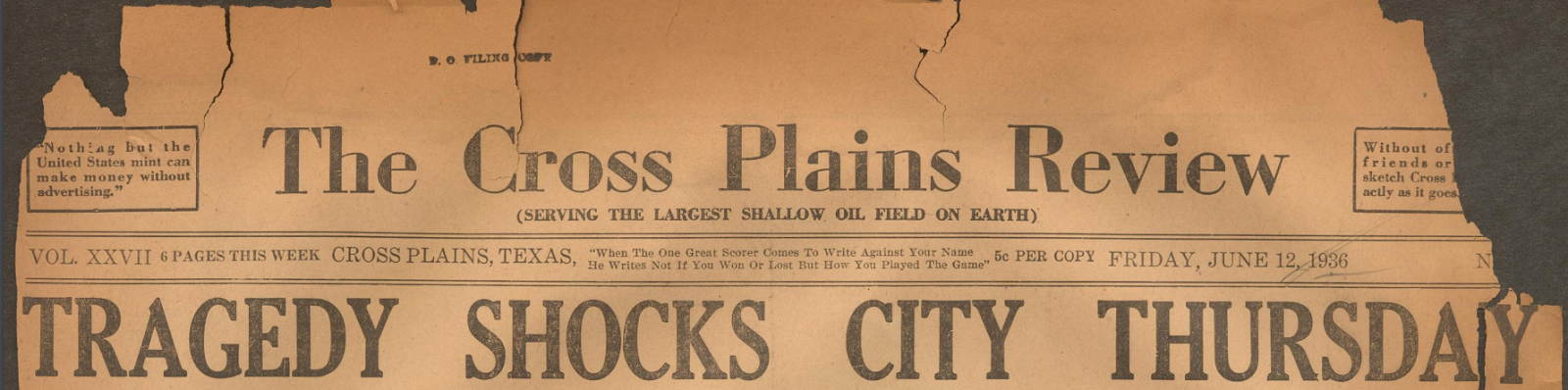
Below are two images of the actual story in the Cross Plains Review, June 12th, 1936 (these scans are of an actual copy of the newspaper. Parts of the right edges of the paper have been worn away from wear over time):
Part 1 Part 2


To say the death of Robert E. Howard was a tragedy is certainly an understatement. He left a large gap not only in the pulp fiction world (esp. in Weird Tales) but also in the general world of fiction. Even so, his works have survived in magazines, academic journals, books, anthologies, and his characters are seen on television, the big screen, comic books, RPG and board games, as well as video games. Howard and his works have become an international phenomenon!
Robert E. Howard's impact has sent waves across the world to a variety of people from all walks of life. And just imagine, it all started in the small central West Texas town of Cross Plains, where his life and works are still celebrated.
A trip report is soon to follow. Cheers!
Todd B. Vick
Sunday, July 6, 2014
Study This, Not That!: A Suggested Bibliography for REH Studies, Part Three
REH Secondary Works . . .
In any form of research secondary works/sources can be crucial. However, it should be pointed out that where there is a secondary source to support a primary source and the primary source is still available, always use the primary source. This is especially true if you end up writing articles/papers on the topic at hand. I don't say this in an attempt to dissuade the use of secondary sources but to emphasize the fact that primary sources are far superior to secondary sources. At the academic level of research to use a secondary source as if it is a primary source is intellectual dishonesty, and always frowned upon.
However, secondary sources are wonderful resources, especially those from learned scholars and experts. And, if a secondary source is the only source available for specific information then by all means use it. But don't be quick to draw absolute conclusions based solely upon a secondary source. I'm not saying anything here that is not already widely accepted in academic circles, and this kind of research methodology has been in practice for decades (centuries even). With that in mind, here are some of the best secondary sources that I have encountered in my research of Robert E. Howard.
History/Historical Documents . . .
Read This . . .

 Current REH studies/scholarship is very fortunate to have Rob Roehm and his father Bob Roehm in the research field digging up REH history and historical documents. I love history. In fact, I love the type of history that most history buffs find boring. The gritty details about people's lives: where they are from, where they went to school, where they used to hang out, where they traveled, why they traveled to these places, how they were raised, who were their relatives, all the documents surrounding these facts, and why that all matters. This is the kind of history that the Roehms have researched, uncovered, and made known to everybody in REH scholarship and fandom. If you are unaware of their works, then you are missing out on one of the most important ingredients in REH studies. Aside from actually tracking down articles that Rob has written (e.g. old REHupa zines, the REH Two-Gun Raconteur website, and other various books/magazines) the Roehms currently have two books available. The first is titled Howard's Haunts: A Photographic Journey Through Robert E. Howard's Texas and Events of the Howard Centennial. I bought this book from the REH House and Museum three or four years ago. It was so interesting I read through the whole book in one sitting and have read it several more times since. It details places like Peaster, Dark Valley, Menard, Howard Payne University, Brownwood, Cisco, Rising Star, Fredricksburg, etc., It also covers events such as REH Days in Cross Plains, the 100th birthday bash for REH in Fort Worth, TX, REH Publications for 2006, and a chapter by Mark Finn about The World Fantasy Convention in Austin, TX in 2006. The book is loaded with historical photographs and current photographs. Their second book is titled The Brownwood Connection: A Guide for Robert E. Howard Fans. This book provides historical details about REH's time in Brownwood during High School, College, and other visits he made to that city. This book is replete with photographs, scans of historical documents, school yearbooks, maps, newspaper articles, legal/court documents, time tables, etc. All accompany a solid written explanation of the facts, documents, events, etc. This book is so detailed at times that even train schedules from back in Howard's day are included. There's even a section about Novalyne Price in the appendices. Any serious researcher should not be without these two volumes. (Note: technically, a lot of this material—especially the actual historical/legal documents—are primary sources. Even so, I've included these works in the secondary sources section due to the current photographs and current travels accounts, esp. in Howard's Haunts, not being essential primary data/sources. However, any historical/legal documents, etc. from this material should be considered primary data and treated as such.)
Another book edited by Rob Roehm I recently purchased is titled School Days in the Post Oaks. As of this article I have yet to read this work so I really cannot review it for you, but I do know (and this is the reason I bought a copy) that it is a collection of newspaper articles about REH and his time/events in the Post Oak area. Click the link I've provided for further details.
Academia . . .
Read This . . .

 Current Robert E. Howard fans are quite fortunate that they have a fairly nice size pool of rigorous academic (and academic type) material in which to swim. This certainly has not always been the case. I will not list single articles that are in larger anthologies here (see a few a those below*). There are single volumes devoted to nothing but Howard studies. It is important to note that with academic material the more current a work, the "better" it is. I do not mean "better" in terms of quality, but rather better in the sense that it is freshest, and the most up-to-date research (and usually considers previous research). The first volume that comes to mind in terms of academia, and the most dated, is Don Herron's edited volume titled The Dark Barbarian. This academic collection, published in 1984, was the first of its kind. And quite frankly, several of the articles still hold up today. For REH academic study I would actually recommend beginning with this volume. Now, I should point out several things here. First, some of the chapters mention dating issues of particular manuscripts, and these issues have currently been resolved thanks to the work of later scholars. Second, some of the chapters are not written in formal academic styles. This is only important in so far as that is probably what kept this volume from making serious inroads into academic circles. Third, there are current articles/volumes that are far more rigorous in their assessment, research, and presentation than this volume. But, as I mentioned before this volume set a precedent and therefore ought to have been taken much more seriously than it was. Another feature of REH studies that does not exist in other academic circles of the same kind is that REH studies/scholars have their own peer reviewed journal. I cannot stress how important this is. I also cannot stress how important it is for REH fans to support this effort and keep it alive by purchasing these journals when they are released. The peer reviewed journal is called The Dark Man: The Journal of Robert E. Howard Studies. The reason this journal is so important is that good solid university libraries always make an effort to obtain all peer reviewed journals in pretty much every field. To have one out there means that Howard's work has a far greater chance of being studied at the university level. Plus, The Dark Man journal must adhere to academic standards (e.g. writing in a particular academic style - MLS). If you can find back issues of these journals you will essentially have found a goldmine of REH articles and research. These journals are a must read in REH research/studies.

 Another excellent volume in the academic category is titled Two-Gun Bob: A Centennial Study of Robert E. Howard. Now, while this volume is not published via an academic/university press, many of the articles are written by professors and scholars (e.g. S.T. Joshi, Frank Coffman, Glenn Lord, Charles Gramlich, Lorenzo DiTommaso, etc.). This anthology is still in print and that says a lot about the quality of its contents since it was published in 2006 (8 years ago since the posting of this article). Another academic volume that was recently published is titled Conan Meets the Academy. This volume was edited by Jonas Prida who is an assistant professor of English and Head of the English department at the College of St. Joseph, Rutland, Vermont. Published by McFarland it is the first academic volume to focus solely on one of REH's characters. The articles are geared more toward the cultural impact REH's character Conan the Cimmerian has had on culture. Even so, it is a great volume to own, the articles are well researched, thoughtful, and well documented.
*Other volumes with single articles about Robert E. Howard's work include Undead in the West II: They Just Keep Coming. This volume contains an article written by Jeffrey Shanks and Mark Finn titled Vaqueros and Vampires in the Pulps: Robert E. Howard and the Dawn of the Undead West. Jeff Shanks also has a nice article in an academic volume titled Pulp Fiction of the 1920s and 1930s. This volume is edited by Gary Hoppenstand and Jeff's article is titled History, Horror and Heroic Fantasy: Robert E. Howard and the Creation of the Sword and Sorcery Subgenre.
Journals, Fanzines, and Miscellaneous Books/Works . . .
Read This . . .
 Over the decades many REH journals and fanzines have come and gone. If you are adventurous, like to collect things, and know where to look you can track down some real jewels. You won't have to work too hard though to get your hands on one of the last surviving REH journals, and one of the better ones to be created (which is probably why it was brought back). The journal I'm talking about is REH: Two-Gun Raconteur. This journal has been around since the 70s—yes, that's a long time. I've been buying copies for at least 5 or so years and have tracked down several back issues. The journal is toted as The Definitive Robert E. Howard Journal, and it lives up to that declaration. It has its origins in the mid 70s, and was the brainchild of Damon C. Sasser. Sasser told me he thought it up in the midst of the REH boom of the 70s when there were only three active fanzines in operation: Fantasy Crossroads (of which I have several issues), The Howard Review, and REH: Lone Star Fictioneer (of which I have several issues). The journal took a bit of a break around the late 80s early 90s and then started back up in 2003 and has since then been published to date. Damon C. Sasser is still the editor today. This journal is always loaded with excellent articles (some on a scholarly level). Here are some of the past contributors: Damon C. Sasser, Patrice Louinet, David Hardy, Brian Leno, Jeffrey Shanks, Barbara Barrett, Rob Roehm, Don Herron, Bill Cavalier, Steve Tompkins, Frank Coffman, Mark Finn, Jim and Ruth Keegan, Michael L. Peters (illustrations), Timothy Truman (illustrations), Charles R. Saunders, Deuce Richardson, Morgan Holmes, Rusty Burke, etc. (I'm sure I've missed a few names). It also includes stories by Robert E. Howard. Each issue is lavishly illustrated. Back issues of these journals are frequently sought. I've seen them sell for as much as $35.00 on Ebay. Current issues are for sale here.

Robert E. Howard: The Power of the Writing Mind is a small independent work allegedly edited by Ben Szumskyj (but in reality edited by Leo Grin, per a reliable source). Regardless of its editor, it is well worth tracking down. It has articles by Joe Marek, Patrice Louinet, Rusty Burke, Leo Grin, stories by Robert E. Howard (An Untitled Story, The Devil's Woodchopper, three autobiographical letters, Double Cross, The Right Hook - this is a photocopy of the actual manuscript, and a High School Theme) illustrations by Gary Gianni, Mark Schultz, images from the portfolio of Rick McCollum Rick Cortes, and David Burton. There is also a nice interview with Glenn Lord. While this is not a crucial volume to own, it is a solid volume and worth getting.
 A good solid book that has provided me with hours of fun reading and information not only about Robert E. Howard but about REH fandom has been The Man From Cross Plains: A Celebration of Two-Gun Bob Howard edited by Dennis McHaney. While this book is not necessarily one that makes for great study and research, it is one that will give you an excellent idea about Cross Plains, TX and REH fandom. I put it in here for that reason. There are some informative chapters that will go much deeper than merely fandom (e.g. Chris Gruber's chapter titled Atavists All? Howard's Boxing Hero's as Throwbacks) but most are fan related, Howard's influences on various people, Cross Plains as a home away from home, etc. Regardless, the book is well worth reading and I highly recommend it.
I hope that this three part series will at least give interested persons a good starting point to really dig their heels in and begin researching the Texas tale-spinner. Keep in mind this list is certainly not exhaustive. It's not intended to be. Anyone reading this who has other suggestions feel free to list them in the comments. I know for a fact more research material is slated to appear in the future, until then happy researching. Cheers!
In any form of research secondary works/sources can be crucial. However, it should be pointed out that where there is a secondary source to support a primary source and the primary source is still available, always use the primary source. This is especially true if you end up writing articles/papers on the topic at hand. I don't say this in an attempt to dissuade the use of secondary sources but to emphasize the fact that primary sources are far superior to secondary sources. At the academic level of research to use a secondary source as if it is a primary source is intellectual dishonesty, and always frowned upon.
However, secondary sources are wonderful resources, especially those from learned scholars and experts. And, if a secondary source is the only source available for specific information then by all means use it. But don't be quick to draw absolute conclusions based solely upon a secondary source. I'm not saying anything here that is not already widely accepted in academic circles, and this kind of research methodology has been in practice for decades (centuries even). With that in mind, here are some of the best secondary sources that I have encountered in my research of Robert E. Howard.
History/Historical Documents . . .
Read This . . .
Current REH studies/scholarship is very fortunate to have Rob Roehm and his father Bob Roehm in the research field digging up REH history and historical documents. I love history. In fact, I love the type of history that most history buffs find boring. The gritty details about people's lives: where they are from, where they went to school, where they used to hang out, where they traveled, why they traveled to these places, how they were raised, who were their relatives, all the documents surrounding these facts, and why that all matters. This is the kind of history that the Roehms have researched, uncovered, and made known to everybody in REH scholarship and fandom. If you are unaware of their works, then you are missing out on one of the most important ingredients in REH studies. Aside from actually tracking down articles that Rob has written (e.g. old REHupa zines, the REH Two-Gun Raconteur website, and other various books/magazines) the Roehms currently have two books available. The first is titled Howard's Haunts: A Photographic Journey Through Robert E. Howard's Texas and Events of the Howard Centennial. I bought this book from the REH House and Museum three or four years ago. It was so interesting I read through the whole book in one sitting and have read it several more times since. It details places like Peaster, Dark Valley, Menard, Howard Payne University, Brownwood, Cisco, Rising Star, Fredricksburg, etc., It also covers events such as REH Days in Cross Plains, the 100th birthday bash for REH in Fort Worth, TX, REH Publications for 2006, and a chapter by Mark Finn about The World Fantasy Convention in Austin, TX in 2006. The book is loaded with historical photographs and current photographs. Their second book is titled The Brownwood Connection: A Guide for Robert E. Howard Fans. This book provides historical details about REH's time in Brownwood during High School, College, and other visits he made to that city. This book is replete with photographs, scans of historical documents, school yearbooks, maps, newspaper articles, legal/court documents, time tables, etc. All accompany a solid written explanation of the facts, documents, events, etc. This book is so detailed at times that even train schedules from back in Howard's day are included. There's even a section about Novalyne Price in the appendices. Any serious researcher should not be without these two volumes. (Note: technically, a lot of this material—especially the actual historical/legal documents—are primary sources. Even so, I've included these works in the secondary sources section due to the current photographs and current travels accounts, esp. in Howard's Haunts, not being essential primary data/sources. However, any historical/legal documents, etc. from this material should be considered primary data and treated as such.)Another book edited by Rob Roehm I recently purchased is titled School Days in the Post Oaks. As of this article I have yet to read this work so I really cannot review it for you, but I do know (and this is the reason I bought a copy) that it is a collection of newspaper articles about REH and his time/events in the Post Oak area. Click the link I've provided for further details.
Academia . . .
Read This . . .
Current Robert E. Howard fans are quite fortunate that they have a fairly nice size pool of rigorous academic (and academic type) material in which to swim. This certainly has not always been the case. I will not list single articles that are in larger anthologies here (see a few a those below*). There are single volumes devoted to nothing but Howard studies. It is important to note that with academic material the more current a work, the "better" it is. I do not mean "better" in terms of quality, but rather better in the sense that it is freshest, and the most up-to-date research (and usually considers previous research). The first volume that comes to mind in terms of academia, and the most dated, is Don Herron's edited volume titled The Dark Barbarian. This academic collection, published in 1984, was the first of its kind. And quite frankly, several of the articles still hold up today. For REH academic study I would actually recommend beginning with this volume. Now, I should point out several things here. First, some of the chapters mention dating issues of particular manuscripts, and these issues have currently been resolved thanks to the work of later scholars. Second, some of the chapters are not written in formal academic styles. This is only important in so far as that is probably what kept this volume from making serious inroads into academic circles. Third, there are current articles/volumes that are far more rigorous in their assessment, research, and presentation than this volume. But, as I mentioned before this volume set a precedent and therefore ought to have been taken much more seriously than it was. Another feature of REH studies that does not exist in other academic circles of the same kind is that REH studies/scholars have their own peer reviewed journal. I cannot stress how important this is. I also cannot stress how important it is for REH fans to support this effort and keep it alive by purchasing these journals when they are released. The peer reviewed journal is called The Dark Man: The Journal of Robert E. Howard Studies. The reason this journal is so important is that good solid university libraries always make an effort to obtain all peer reviewed journals in pretty much every field. To have one out there means that Howard's work has a far greater chance of being studied at the university level. Plus, The Dark Man journal must adhere to academic standards (e.g. writing in a particular academic style - MLS). If you can find back issues of these journals you will essentially have found a goldmine of REH articles and research. These journals are a must read in REH research/studies.Another excellent volume in the academic category is titled Two-Gun Bob: A Centennial Study of Robert E. Howard. Now, while this volume is not published via an academic/university press, many of the articles are written by professors and scholars (e.g. S.T. Joshi, Frank Coffman, Glenn Lord, Charles Gramlich, Lorenzo DiTommaso, etc.). This anthology is still in print and that says a lot about the quality of its contents since it was published in 2006 (8 years ago since the posting of this article). Another academic volume that was recently published is titled Conan Meets the Academy. This volume was edited by Jonas Prida who is an assistant professor of English and Head of the English department at the College of St. Joseph, Rutland, Vermont. Published by McFarland it is the first academic volume to focus solely on one of REH's characters. The articles are geared more toward the cultural impact REH's character Conan the Cimmerian has had on culture. Even so, it is a great volume to own, the articles are well researched, thoughtful, and well documented.*Other volumes with single articles about Robert E. Howard's work include Undead in the West II: They Just Keep Coming. This volume contains an article written by Jeffrey Shanks and Mark Finn titled Vaqueros and Vampires in the Pulps: Robert E. Howard and the Dawn of the Undead West. Jeff Shanks also has a nice article in an academic volume titled Pulp Fiction of the 1920s and 1930s. This volume is edited by Gary Hoppenstand and Jeff's article is titled History, Horror and Heroic Fantasy: Robert E. Howard and the Creation of the Sword and Sorcery Subgenre.
Journals, Fanzines, and Miscellaneous Books/Works . . .
Read This . . .
Robert E. Howard: The Power of the Writing Mind is a small independent work allegedly edited by Ben Szumskyj (but in reality edited by Leo Grin, per a reliable source). Regardless of its editor, it is well worth tracking down. It has articles by Joe Marek, Patrice Louinet, Rusty Burke, Leo Grin, stories by Robert E. Howard (An Untitled Story, The Devil's Woodchopper, three autobiographical letters, Double Cross, The Right Hook - this is a photocopy of the actual manuscript, and a High School Theme) illustrations by Gary Gianni, Mark Schultz, images from the portfolio of Rick McCollum Rick Cortes, and David Burton. There is also a nice interview with Glenn Lord. While this is not a crucial volume to own, it is a solid volume and worth getting.
I hope that this three part series will at least give interested persons a good starting point to really dig their heels in and begin researching the Texas tale-spinner. Keep in mind this list is certainly not exhaustive. It's not intended to be. Anyone reading this who has other suggestions feel free to list them in the comments. I know for a fact more research material is slated to appear in the future, until then happy researching. Cheers!
Subscribe to:
Posts (Atom)