Sunday, February 28, 2016

An Overview of Robert E. Howard's Poem: "The Ballad of King Geraint" By Barbara Barrett

The Roman Wall

“The Ballad of King Geraint” is an action filled tale of brave knights and feats of derring-do in the battle between King Geraint of Britain and the Saxon hordes who encroached on his kingdom. Many of the participants’ names are familiar to Howard fans.

The poem is twenty-nine pages—too long to reprint. Here are some excerpts as well as a Cast of Characters list:

King Geraint ruled the western land
From the Roman Wall to Channel’s sand;
The Saxons held the eastern coast
By high-beaked galley and spear-tipped host.
They reached their hands from the eastern shore
And flooded the land with fire and gore.

King Geraint marched on the Watling Road,
Along the Ouse his banners showed.
Few his warriors but fierce his lords,
Dipped and reddened their worn swords.
He had scoured the land a-near and far,
He had sold his crown for the thews of war.
Knight and warrior and man-at-arms,
Yeoman drawn from the ravished farms,
Each was armed to suit his need,
Each one rode on a goodly steed.
The hoof-beat thunder sounded far—
So Geraint rode to his last red war.

List of Characters

The poem contains many similar names. In order to follow and understand the battle action, here is a list of which characters fought on what side and in parenthesis who was killed by whom.

On the side of Britain is King Geraint (unknown slayer) with ten knights and 1,000 men.
Angus, a chief of the northern Scot (dies from wounds after the Saxon foot soldiers flee in the third encounter)
Cadallon, the king of Wales (killed by Lodbrog in the third encounter)
Conal, close friend of King Geraint (killed by Oswald in the second encounter)
Conmac flower of knighthood (killed by Eadward in the final battle with King Caewlin) 
Cormac of Cornwall called the Hawk (killed when overwhelmed by the hordes of Saxon foot soldiers in the third encounter)
Donal, the chieftain of Strathclyde (Donal and Hakon the jarl kill each other in the first encounter)
Dulborn, a Pict (Dulborn and Tostig the Raven kill each other in the final battle with King Caewlin)
Nial, brother to Ulster’s king (unknown slayer)
Turlogh of Connacht (sole survivor of Geraint’s men)
Uther, king of Humber, whose kingdom was destroyed by Anlaf (killed by Edric and Athelstane in the third encounter)

Ceawlin, king of the Saxons (survives) with 12,000 warriors. His army was divided into five groups with four commanders and himself. His four commanders are listed in the order they battle King Geraint and his knights.

1. The first encounter, led by Prince Osric, a Jut, ruler from Ouse to Humber, commanding 1000 horsemen. (killed by King Geraint) 

Athelney. berserker (killed by Angus the Scot)
Athelred, cousin to the king, (killed by Donal)
Halfgar, Frisian sea-king (killed by Conal who receives a mortal wound)
Oswick who ravaged London town (killed by King Cadallon of Wales)
Oswy the Jut (killed by Uther)
Otho the thane of the Black Boar’s Tooth (killed by Cormac)
Norseman Rane, (killed by Nial)
Rognor of the golden ring. (killed by Conmac)
Viking Swane. (killed by Turlogh)
Tostig the Ogre, berserker (killed by Dulborn the Pict)

2. The second encounter, led by Oswald, lord of the Sussex plain commanding 1000 horsemen. (killed by King Geraint after Oswald kills Conal)

Aella ruler from Tweed to Tyne (killed by Nial)
Anlaf the Angle who killed Uther’s family and ravaged his kingdom (killed by Uther who cuts off his enemy’s head and displays it)
Athelfrith (killed by Angus)
Godric (killed by Cadallon)
Gulla (killed by Turlogh)
Gurth (killed by Dulborn)
Hakon the jarl (killed by Donal in a charge that kills them both)
Jan the Lith (killed by Angus)
Wulfhere, chieftain of Horsa’s line (killed by Conmac)
Wutholwine (killed by Cormac)

3. The third encounter was led by both Athelstane, a Wessex ealdorman (killed by King Geraint) and Edric of Orkney Isles, a Dane (killed by Nial); they were co-commanders of the 8,000 foot soldiers.

4. The final battle was led by King Ceawlin himself with 2000 horsemen. Under his immediate command were:


Tuesday, February 16, 2016

Robert E. Howard's Conan Roleplaying Game by Chris Birch, Modiphius


"Know, oh prince, that between the years when the oceans drank Atlantis and the gleaming cities, and the years of the rise of the Sons of Aryas, there was an Age undreamed of, when shining kingdoms lay spread across the world like blue mantles beneath the stars..."


ROBERT E. HOWARD’S CONAN: ADVENTURES IN AN AGE UNDREAMED OF is a brand new roleplaying game based on the incredible character of Conan and of the Hyborian age.


...all under the watchful eye of world-renowned Conan experts and scholars including Jeffrey Shanks, Patrice Louinet and Mark Finn, working together to bring you the most authentic Conan roleplaying experience yet, focusing exclusively on Robert E. Howard’s original stories.


The project has a solid line-up of stretch goals. Each level of participation offers excellent rewards. This is hands down the ultimate Conan RPG game currently available, so don't miss it. You can go directly to the Kickstarter campaign here.

Thursday, February 11, 2016

Others and Skull-Face By Karen Joan Kohoutek

"We found ourselves instinctively suspicious of anything out of the ordinary." —Robert E. Howard, from "Skull-Face," Tales of Weird Menace (58)

        In the story “Skull-Face” (originally published in 1929), Robert E. Howard spends some time making sure we know that its narrator, Steve Costigan, is an exile from society, set apart from decent or normal people. He is "a dirty, ragged renegade" (5), "a wounded soul" (37), addicted to hashish, who has "crossed an ocean over which I could never return," and whose “moral sense had been blunted" (6, 20).
 
Ken Kelly's depiction of The Tomb of Deception
Significantly, he is also a shell-shocked veteran of World War I, where he had been "shot and bayoneted to shreds of gory flesh" (7). In the opium den, we overhear a sailor cry out "Muster all hands on deck" (8), reminding us that Costigan isn't the only traumatized veteran to have found refuge in this Temple of Dreams. They fought for a cause, for their country, and they have been tossed aside, the same way "the men who died beside me in No Man's Land" were (33).

Unknown to the everyday opium-eaters, however, this particular den is the headquarters of a global conspiracy to "drive the white men into the sea" (48). Led by Kathulos, a mysterious skull-faced survivor of Atlantis, the political situation is described as one of "widespread unrest" among different groups, mostly in countries that were at the time under British rule or influence; one passing example given is that "the African cauldron began to seethe" (64).

When Costigan encounters the conspiracy, he is tempted into cooperating with it, not by the promise of riches or power, but with the question "Would you like to be a man again? … I am a friend to all broken men" (9). The larger world didn't have any patience for the brokenness of men like Costigan. Seeing him as a useless addict, rather than someone who lost everything in the war, "normal" society hasn't cut him any slack. Offered the chance to make something of himself again, the protagonist turns against "normal" society, and aligns himself with the masses against it, at least temporarily.

In a 1923 letter to Tevis Clyde Smith, Howard asked, "Who will our invaders be? From whence will they come? Where but from Asia? Can a nation ally the Tartars, the Mongols, the Indians; the tribes of Asia? Buddhist, Bonist, Bramin, Erlikist, Mohammedan? Unite them and hurl their united strength against the rest of the world? Such a nation would rule the world" (Collected Letters 14).

In another letter a few weeks later, Howard says "a color-war I would enter gladly with no scruples or any thought except to get as many as possible" (15). This sounds wildly racist, but it's followed up with a whole list of reasons why Asia has the advantage over the West, with many of the examples -- such as "Before the time of Alexander the Great, China had a civilization nearly equalling any today" (16) -- painting it as a superior culture. And the original musing on these hypothetical future invaders followed a list of who'd conquered whom throughout history: "England had her Norsemen, her Scots, her Normans…" (14). 

Norman assault on the army of King Harold in 1066
The real mood here is one of historical reflection, with the recognition that all empires are vulnerable, and all civilizations eventually meet an enemy which can cause their downfall. Howard logically follows this by facing the implications for the civilization of his own time. If the pattern were to be repeated in his lifetime, with one group of people forcing out another, then to fight on one side of this "color-war" would be a matter of survival, with one’s personal prejudices or lack thereof being a moot issue.


If Kathulos, for example, had been successful in his worldwide revolution, it wouldn't bode well for the white population. Where the conflict specifically involves the choice between a white Empire and a black Empire, then the main basis most people would use to support one side or another is whether they are white or black. Self-interest is an understandable, instinctive reaction, albeit one that doesn't showcase humanity at its best.

Kathulos is, in a sense, doing what's natural, working for the survival of his own people. His ultimate goal is to preserve his own race. "I must work and labor for the good of the race at large. Aye, I must toil and sow the seed of glory against the full coming of the imperial days" (84). The villain’s race loyalty makes him an enemy to the whole of humanity.

Many people wouldn't want to live in an empire whose rulers and privileged classes are all of a single racial group that they don't belong to. That recognition may provide an uncanny, if not consciously recognized, twinge of empathy for how it feels for the people who are already in that situation: in this case, the natives whose uprising the story’s British agent John Gordon is trying to thwart. The fear of being white in a black-ruled world may suggest that, deep down, people realize there's something wrong with a system that ascribes merit to race, applicable to the already existing situation of those who are black in a white-ruled world. After all, one's race is arbitrary, a fluke of fate.

Too often, unfortunately, when the interests of different groups are in conflict, individuals align on the basis of biased self-interest, and what will benefit them most. In cases where one race is in power over another, as in the British Empire of "Skull-Face," one of the justifications frequently invoked is the idea that one group is intrinsically superior to the other. Often, that superiority is morally defined: thus, the Empire justifies subjugating native people in their own countries because the British deserve to rule them -- they're bringing civilization to the savages.

The ruling class of African natives
This notion, however, puts a burden on the group in power to actually be morally superior. The cornerstone of Kathulos' plot is "dope! … with this he ensnares and enslaves men and women” (Tales 49) The ruling class, the superior people who deserve to rule the world, are easily lured into drug addiction, while at the same time, the different minority groups under their rule are able to put aside their conflicts with each other and rally for their own liberation.

  When Gordon recruits Costigan to become a double agent, it’s because the addict's alienation from society has accidentally put him in a position to infiltrate that society’s enemies. Costigan doesn’t hesitate when offered the chance to redeem himself by working again on behalf of the mainstream. This is depicted pretty unambiguously as in aid of "civilization" against native unrest and a conspiracy to overthrow the rule of white men: "Here, in the very heart of civilization's metropolis, the direct enemy of that civilization commits crimes of the most outrageous nature…" (56)
 
        Eventually, however, the definitions change. Kathulos says that Costigan is "always the barbarian" (81), and refers to the dangers of "lift(ing) the savage from his savagery." The shift becomes more explicit when Kathulos refers to "you white barbarians, whose ape-ancestors forever defied my race and me" (83). In relation to the Atlanteans, all the other races are barbarians, and the ones who rebel against the rule of a self-defined superior race are the ones the story positions as heroic.
    
        As Kathulos tells Costigan, "I have created a Frankenstein monster. I made of you a superhuman creature to serve my wishes and you broke from me" (8). This cry could just as easily come from a Bearer of the old-fashioned White Man's Burden. Colonizers have long justified their actions by stressing what they gave to the colonized, making them what they are, and long believed the native peoples should be grateful for what they’ve done, instead of rebelling.
 
In fact, Kathulos could easily have referred to those humans who resist Atlantean slavery as a seething cauldron of unrest, the way Gordon refers to other nations’ resistance to British rule. The return of the "ancient masters" would mean the enslavement of the rest of humanity, and those slaves probably aren't going to appreciate that "civilization," which raises the question of whether the British Empire presented civilization in its best possible light to the native populations of the countries that were in on Kathulos' conspiracy, and how wrong they really were to lack appreciation, instead choosing to rebel.

        An important part of the story is that Kathulos has united different groups against a common enemy, an act which Gordon calls a "monstrous conspiracy" (49). They come from Afghanistan, China, Senegal, Haiti, Morocco, India, and "secret native societies of West Africa" (51). There's no corner of the globe where the British haven't made deep-seated enemies. Unfortunately for all sides, Kathulos, the being who is uniting these disparate peoples, is a killer who seeks to enslave all of humanity. Liberation is a dream, promoted by exploiters who dupe the exploited for their own ends.
       
        Howard presents a cynical view of the world in this story, suspicious of the Utopian impulse, and certainly of Messiah figures. This story's scenario is reminiscent, for example, of "Black Canaan," albeit on a much grander scale. A group of people, who certainly have legitimate grievances, are being manipulated by someone with sinister, selfish intentions, who doesn't really care about the well-being of his followers, and who will readily turn on them. There's always an agenda based on the desire for personal power.

        In the case of Kathulos, he openly says: "These brown and yellow people, what care I for them?" (83) His black followers, who think they're rallying to gain the power they've been denied, are really just pawns, trading in one kind of oppression for a more blatant kind of slavery.

        As for the race which had previously enslaved the black one, Kathulos crows that "when I mount my universal throne, the only whites shall be white slaves!" (83) Since he's a megalomaniacal pulp villain, and not a real-life politician, he doesn't feel the need to justify his enslavement of other races in any way, but he clearly believes that the people he's enslaving are inferiors, those "barbaric races" whose history is made up of "long years of savagery" (83). He believes his civilized Atlantis is superior to barbaric human culture. All of this echoes the sort of rhetoric historically used by the white races to justify slavery and colonization.

In other words, Western Civilization is in the same relationship to the Atlanteans as the seething cauldron of native populations are to the British Empire. So while the story started out with the British Empire defending white civilization from barbaric hordes, made up of people from races that are perceived as more primitive, it ends up as a contest between the "barbarism" of those same white men versus the civilized, but blatantly evil, Kathulos. With "barbarism" being the preferred state.

  The parallel works both ways, so the story also links the heroic "barbarism" of white men fighting ancient evil with the uprisings against that same white civilization. In contemporary sociology and literary theory, there is a popular notion of “the Other.” J.-F. Staszak has succinctly described this as “applying a principle that allows individuals to be classified into two hierarchical groups: them and us.” In this framework, “the out-group is only coherent as a group as a result of its opposition to the in-group,” and “the in-group constructs one or more others, setting itself apart and giving itself an identity.” He adds, “Dominated out-groups are Others precisely because they are subject … to the dominant in-group” (43).
       
        However one feels about the validity of the idea, it is an influential one in critical circles, and can provide a useful lens for looking at issues of difference (including racial difference) and social power imbalances. It also describes the layers of differentiation that occur between racial groups in Howard’s tale: the taken-for-granted “othering” done by the white, British population to other races and nationalities mimics the position they’re going to be in vis-à-vis the Atlanteans.

        So on the surface, the plot of "Skull-Face" can easily be seen as an example of white society's fear of the Other, as represented by those diverse races dominated by the British Empire. But once it introduces Kathulos’ assumption of racial superiority, his ascending to power would equally position white society as the Other, and the whole interpretive framework turns topsy-turvy.

        This illustrates that there is no intrinsic or immutable superiority in one group or the other, but merely historic forces and generations of time in which positions may switch, so that one generation’s primitive savages could, in the far future, complacently believe themselves the epitome of civilization.

The central situation of the story reveals both barbarism and civilization to be a matter of perspective. If that's true, and the perspective depends on which group you happened to be born into, what does it even mean? A few years after writing this story, Howard would ask Lovecraft that very question: "Just what is civilization? Where does barbarism leave off and civilization begin?" (A Means to Freedom 547).
        In the example of "Skull-Face," if someone new can come to power and re-define the race-based class structure, what validity does that structure even have? Especially when the race that was presumed to be "superior" has become decadent, losing itself in drug addiction? Howard could have written a more simplistic tale of "yellow peril," with noble white men fighting dehumanized hordes of rebellious savages, but instead he depicts a much more multilayered of racial tensions. With its mixing up the categories of civilized and barbaric, the story can be seen as identifying in some way with the rebels, and displaying a subtle distaste for the civilization the hero is defending.
       
        The events of "Skull-Face" may not make the representatives of British imperialism more sympathetic to the "unrest" of people under their dominance, once "Africa has subsided and the East seems to have returned to her ancient sleep" (92). Part of the story's irony is that the old Empire was rescued with the help of an outcast, a man who was, in a sense, betrayed by the very society he's now fighting to defend. He risked his life in war, and when he was damaged by it, the only support he found was in an opium den, with the lowest of the low.

In some respects, then, Costigan and the rebels have more in common than he'd ever realize, and one thinks they could have, in some sense, been on the same side. The Kathulos hasn't come along yet who can make the white man of "Skull-Face," who has been cast out of society, see his common cause with the Africans and Asians who share his powerlessness.

Works Cited
Howard, Robert E. Collected Letters of Robert E. Howard, Volume One. The Robert E. Howard Foundation Press.

Tales of Weird Menace. The Robert E. Howard Foundation Press, 2010.

A Means to Freedom: The Letters of H.P. Lovecraft and Robert E. Howard. Two Volumes. Edited by S.T. Joshi, David E. Schultz, and Rusty Burke.

Staszak, J.-F. Other/Otherness. International Encyclopaedia of Human Geography. Vol. 8, pp. 43 - 47.  Oxford: Elsevier, 2009.


Sunday, January 31, 2016

An Escape from The Depression: The Fantasy Fan, Marvel Tales & The Pulps by Todd B. Vick

The Great Depression was the longest lasting economic downturn in the history of mankind. It not only had a deep effect here in the U.S. but the rest of the world felt its squeeze as well. Despite its woes, those who lived through The Great Depression still had to get on with their lives and try and find a way to survive. By 1933 when the Great Depression had reached its nadir, some 15 million people in the U.S. alone were without work, almost half the banks in the U.S. had closed their doors, and Americans (as well as the rest of the world) were in dire straits. However, in the midst of this nadir, the entertainment industry was booming. People were trying to forget their troubles by turning their attention to films, sports (in large part boxing), books, magazines and other distracting things.

     In 1933 some of the greatest classic films were released: King Kong, Duck Soup, I’m No Angel, Queen Christina, Little Women, and others. The first drive-in movie theater was built in Camden, NJ that year, and MGM worked on gaining the rights to a film titled The Wizard of Oz. In June of 1933, Primo Carnera defeated Jack Sharkey in the sixth round (with a KO) to win the World Heavyweight Championship. That same year, Jerry Siegel and artist Joe Shuster created the iconic character “Superman.” Underneath all these hugely popular events a seventeen year old teenager was hard at work developing the first fanzine for the weird fiction genre in hopes that it would attract some of the most popular writers in the Weird Fiction and Science Fiction pulp magazine industry.
     
Charles D. Hornig, from New Jersey, was a huge fan of weird fiction and science fiction. He was a regular subscriber to Wonder Stories and Amazing Stories. There’s no written history/information on why or where Hornig got the idea of beginning a fanzine. Even so, Hornig contacted the editor of “The Science Fic-Digest”—Conrad H. Ruppert—in an attempt to find out how such an effort could get off the ground. Ruppert guided Hornig in his endeavors, and in September of 1933, volume 1, no. 1 of The Fantasy Fan was first printed. It is believed that Hornig, a somewhat long time reader of Wonder Stories, sent a copy to its publisher Hugo Gernsback (who has been called the Father of Science Fiction). Through a series of circumstances, Gernsback had recently fired his editor, David Lasser, and after seeing Hornig’s first issue of The Fantasy Fan, hired Hornig. This is apparently confirmed in The Fantasy Fan Oct. 1933, Volume 1, no. 2 issue. “Managing Editor: Wonder Stories” is typed in that issue under Hornig’s name on the title page.  This would certainly explain how Hornig was able to get such high profile authors during The Fantasy Fan’s existence between Sept. 1933 to Feb. 1935.

     The first writers to jump on board Hornig’s fanzine were Clark Ashton Smith, H.P. Lovecraft, and August Derleth. Other writers would join the fanzine in its first year: Julius Schwarts (who would eventually make his name in the comic book industry), Forrest Ackerman (magazine editor and an agent for Sci-fi writers such as Ray Bradbury, Isaac Asimov, L. Ron Hubbard, etc.), R.H. Barlow (author, poet, and previous executor of H.P. Lovecraft’s literary estate) and Robert E. Howard. In its second year, Robert Bloch made a contribution. The circulation of The Fantasy Fan is unknown. My guess is that it was fairly exclusive. Additionally, according to Wikipedia, here are some of the new stories from weird fiction authors that appeared in The Fantasy Fan,
First publication of several works by noteworthy authors occurred in The Fantasy Fan, including works by Lovecraft, Smith, Robert E. Howard, August Derleth, and Robert Bloch. Perhaps one of the magazine's greatest achievements, though, was the serialization of the revised version of Lovecraft's Supernatural Horror in Literature (October 1933-February 1935); the serialization proceeded until it had reached the middle of Chapter VIII and the magazine folded. The Fantasy Fan also saw the first publication of Lovecraft's stories: "The Other Gods" (November 1933) and "From Beyond" (June 1934) as well as reprints (from amateur papers) of "Polaris" (February 1934) and "Beyond the Wall of Sleep" (October 1934); it also published the poems "The Book" (October 1934), "Pursuit" (October 1934), "The Key" (January 1935), and "Homecoming" (January 1935) from Lovecraft's sonnet cycle Fungi from Yuggoth. Lovecraft was represented in no less than seventeen of the eighteen issues published. The October 1934 issue was dedicated to Lovecraft.

     
Marvel Tales w/Slipcase
The Fantasy Fan
Fortunately, a little over 5 years ago (in 2010), Lance Thingmaker put together an extremely nice hardback facsimile of The Fantasy Fan. The collection was limited to 100 copies and sold rather quickly on Ebay. In its heyday, The Fantasy Fan was a way for fans and writers to connect. Also, for those people who were reading the pulps and various science fiction and fantasy magazines, this was just another way for them to find a little escape from the hardships of the Great Depression.

     In the same year that The Fantasy Fan ceased publication, another fanzine called Marvel Tales began publication.  Marvel Tales was edited by William L. Crawford. He was the first to use the name Marvel Tales which would be subsequently used again several times after Crawford’s zine ended. William Crawford was a publisher and editor who also wrote science fiction stories. Crawford lived in Everett, PA and had been an ardent science and weird fiction fan. He was also responsible for the inception of another non-paying weird fiction zine titled Unusual Stories. His Marvel Tales zine had a very short run, all of 5 issues. However, he was able to garner a few top-notch fantasy and science fiction authors of the day to contribute: H.P. Lovecraft, August Derleth, Robert E. Howard, and Frank Belknap Long.

     Marvel Tales has a more mysterious history and demise than The Fantasy Fan. After the fifth issue, the magazine announced with great enthusiasm that its next issue would be on newsstands. After this last mention, no other issues were printed. It disappeared. This was probably due to its non-professional (non-paying) status and the high costs of publishing such a zine in the 1930s. It also never gained a strong enough readership to keep it alive. There is scant material written about Crawford’s Marvel Tales. Even so, in 2012, Lance Thingmaker, after the success of his facsimile for The Fantasy Fan, created a facsimile for Marvel Tales. Thingmaker did a 300 print run with the first 100 books tagged, numbered, and placed in nice slipcases.
     
In the 1930s, if fans of the pulps were fortunate enough to hear about these two fanzines, they would have access to original stories written by some of the more popular pulp writers. Moreover, the paper quality of these fanzines was a notch better than those of the pulps. Like films and sporting events, these fanzines and especially the pulp magazines were a nice inexpensive escape from the troubles that stemmed from the Great Depression. 1939 fanzines more or less fell by the wayside to World War II, dime novels, and the comic book industry. However, weird fiction and science fiction fanzines made a strong comeback in the early 1970s, but eventually faded again toward the mid to late 80s. Fortunately, the stories have survived through the years and are enjoying a steady growth today with a surge of new fans.

Friday, January 22, 2016

On the 110 Anniversary of Robert E. Howard's Birth by Todd B. Vick

On this day (January 22nd) back in 1906, Hester Ervin Howard gave birth to Robert. Just prior to Robert's birth, the Howard's were living in an area called Dark Valley. Toward the time Hester was to deliver, Dr. Howard took her to a little bit bigger community, Peaster, Texas to give birth to their boy. At the time of Robert's birth, the attending doctor documented the wrong day—January 24th, 1906—as seen in the Register of Births pictured below. Damon Sasser has two great posts about this issue at his blog (Two-Gun Raconteur) that can be read here & here.

Parker County's Register of Births - notice the date is incorrect.

Interestingly, the date from the Register of Births—January 24th, 1906—also appears on the historical marker that sits next to the Howard Family headstone in the Greenleaf Cemetery, Brownwood, TX. Apparently, according to Damon Sasser, the person who wrote the application for the marker took the erroneous date from de Camp's biography, Dark Valley Destiny. The Historical Society of Texas declared that they could replace the marker for a sum of $1200.00. Perhaps a fundraiser for this cost can be performed and a new marker with more accurate verbiage can be created.

The Marker at Robert E. Howard's grave site
Little did the Howards know at the time of their son's birth, he'd grow to be a world renown writer, creating some of the most memorable characters and several sub-genres in adventure and heroic fantasy. Because of Isaac M. Howard's occupation, a family doctor, the Howards moved around quite frequently until Robert was thirteen, in 1919 when the family settled in Cross Plains, Texas. At the time the Howard family settled in Cross Plains, it was in the midst of an oil boom. During these oil boom periods, the town would see a strong surge in population. Once the boom abated, the population would drop back down to the regular residency size. These oil booms had a strong impact on young Robert. He would encounter some unusual and wild characters, fodder for his future writing career. Later in adulthood, Howard discussed these oil booms in his correspondence with fellow writer H.P. Lovecraft.

In his later teen years, Howard had some success at writing which helped to prompt him to submit stories for some of the magazines he was reading at the time.  In July 1925, at the age of just nineteen, Howard's story Spear and Fang was published by a struggling pulp magazine called Weird Tales. This was all it took, Howard would spend the next eleven years creating stories around memorable characters such as Solomon Kane, Bran Mak Morn, Kull, El Borak, sailor Steve Costigan, Cormac Mac Art, Breckinridge Elkins, Buckner J. Grimes, Pike Bearfield, and of course, Conan the Cimmerian along with many others; one of my personal favorites is Corcoran. Howard also was a prolific poet, writing some 700 or so poems.

Howard's most popular character, Conan the Cimmerian, has crossed several pop culture boundaries. Conan can be seen in books, comic books, movies, television shows, board games, role-playing games, graphic novels, and video games. In the last 80 plus years, Conan's popularity has only increased. Another of Howard's characters, Solomon Kane, has also seen the silver screen in a relatively recent film titled after the character's name. Michael J. Bassett placed the character in a European film that garnered so much success the film was able to make a U.S. debut on August 24th, 2012. While the character and story line in Basset's film was different from Howard's Kane, at least, the film helped various viewers who had no idea who Robert E. Howard was, find out about the author. One such person was Anne Rice, who on her Facebook wall announced that she saw the film and wanted to read more works from Robert E. Howard. I promptly sent her titles of the Del Rey books and she thanked me for providing them to her.

With a new multi-million dollar board game on Kickstarter to an upcoming documentary titled Riddle of Steel about Conan the Cimmerian, Howard's popularity is ever increasing. So, on this day of days for Robert E. Howard, raise a glass, read a few lines from one of Howard's poems, or pick up your favorite Robert E. Howard story in celebration of his 110th birthday!

Happy Birthday, Robert E. Howard.  Cheers!

January 22nd, 1906—June 11, 1936

A picture of the Howard Family Bible
Notice the date of birth for REH
Jan 22 1906


Thursday, January 14, 2016

Howard Days 2016

This was recently announced on the Robert E. Howard Days Facebook Page . . .

The Robert E. Howard Foundation and Project Pride of Cross Plains, Texas are proud to announce the dates and Guest of Honor for the 2016 version of Howard Days, to be held June 10th and 11th at the Robert E. Howard Museum in Cross Plains.

This year’s Guest of Honor is Michael Scott Myers, screenwriter for the movie The Whole Wide World, the biographical film based on the book One Who Walked Alone, which recounted the relationship between Robert E. Howard and Novalyne Price. We are happy to welcome Michael as our GOH, as he is the perfect person to blend with our Howard Days theme this year, Anniversaries.

2016 finds us with a number of important Robert E. Howard Anniversaries: 110 years since his birth, 80 years since his death, 70 years since the publication of Skull Face and Others, 50 years since Conan the Adventurer from Lancer, 40 years since Glenn Lord’s The Last Celt, 30 years since Novalyne Price Ellis’ One Who Walked Alone and 20 years since the movie The Whole Wide World (which was based on Novalyne’s book).

Michael’s involvement with The Whole Wide World began with his being a student of Novalyne Price Ellis in Lafayette, LA. Having read her book about Howard, he knew what a wonderful movie it would make. So, our Guest of Honor is doubly qualified this year and we’re thrilled to have him.

There is lots more information to follow and you can read about it here and at the Howard Days blog. While the cold winds of January are blowing now, make plans to come to Texas in June where the warmth will be in both the air and in the fellowship of Robert E. Howard fans!


If you have not yet attended Howard Days, try your best to make this year's event. I can tell you from personal experience it is the highlight of my year, well worth the trek. This year's Howard Days is already starting out exciting. I hope to see you there!

Todd


Thursday, December 31, 2015

A Book Review: The Unique Legacy of Weird Tales by Todd B. Vick

This review is a month or so late, but with looming deadlines for writing projects, more on the horizon, and working 70 hour weeks, it’s a wonder it got finished at all. Lauren Bucca at Rowan & Littlefield was kind enough to mail me a review copy of this book. I’m very glad she did. I’ve read about a dozen or more academic anthologies on the various writers of Weird Tales, with an emphasis on Robert E. Howard, H.P. Lovecraft and Clark Ashton Smith. While some have been hit and miss—meaning, some of the chapters in a volume have been very good, others not so much—this volume was faithfully strong throughout.

Edited by Justin Everett and Jeffrey H. Shanks (chair and co-chair of the pulp studies for the Popular Culture Association), this volume covers nearly every aspect of Weird Tales (the pulp fiction magazine) and some of its most popular writers from the early years. There are chapters devoted to the history of Weird Tales, literary reflections, and/or movements within its pages (e.g. weird modernism), collaborations of its writers, genres that stem from it (e.g. sword & sorcery), with special attention to H.P. Lovecraft and Robert E. Howard, and other topics. While this review will not be a chapter by chapter review per se, I will attempt to cull and discuss what I thought were some of the more interesting chapters and briefly describe the others (which are also very interesting and well worth reading).

Jason Ray Carney begins the volume with a discussion about the tenuous history of Weird Tales magazine, its lower than imagined level of readership—peaking at around fifty-thousand readers at the height of its popularity. He also details just how frail the magazine’s financial state throughout its existence. This chapter brings to the forefront some surprising facts and nice information, laying the nice groundwork for the over-all volume. If you are new to Weird Tales, then by all means read this chapter.

Jonas Pridas’ chapter on modernism within the pages of Weird Tales is quite interesting. Declaring that modernist writers were published in pulp magazines, they have, none-the-less been largely ignored. He takes a birds-eye view of modernist literature (some weird and some not) inside and outside of the magazine Weird Tales. Pridas discusses trends in various Modernist frameworks of weird literature, including science, Darwinism, and devils.

Daniel Nyikos discusses Weird Tales writers within the Lovecraft Circle. This is a group that carries on regular correspondence with H.P. Lovecraft and each other, developing friendships with each other as they shared ideas, interests, and stories. Nyikos calls them a type of literary intelligentsia. This chapter was quite interesting since it details how these writers carried on with one another and their work.

Morgan T. Holmes’ chapter on the sword-and-sorcery in Weird Tales has, of course, a strong emphasis on Robert E. Howard and Conan the Cimmerian. However, Holmes also takes a look at Clark Ashton Smith and C.L. Moore’s contributions to the sword and sorcery sub-genre. Delving into the origins of sword and sorcery, Holmes demonstrates how the sub-genre develops and ultimate folds into current authors' works. He also has a section called ‘Sword-And-Sorcery Oddities’ that is intriguing, examining a few writers of note who perhaps made small but important contributions to Weird Tales and the sword and sorcery sub-genre.

Lately, scholars have been delving into issues of sex within the weird fiction genre. One such scholar is Bobby Derie, an H.P. Lovecraft aficionado. His chapter titled ‘Great Phallic Monoliths’ examines the use of sex, or the lack thereof, in Lovecraft’s stories. While some see this type of academia as fringe, even unnecessary, often times these kinds of studies uncover aspects about writers that help us understand why they used the source material they did and why they wrote some of the things they did. So, dismissing this type of critical research is not altogether wise. And, Derie is a leading scholar in this field. His chapter examines the sexual nature of Lovecraft and what various biographers and other HPL scholars have said about the topic, adding, of course, his own research to the issue.

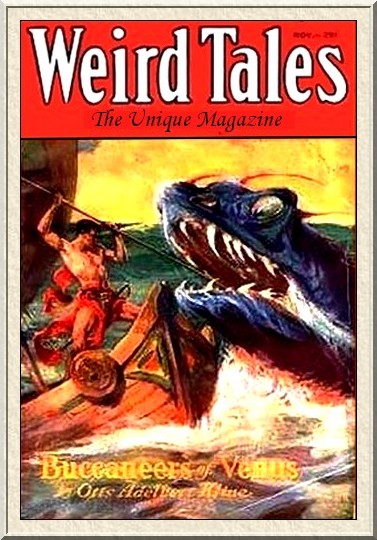
Weird Tales, November 1932
The editors, Everett and Shanks each have excellent chapters well worth reading. Shanks delves into Robert E. Howard’s work titled 'Worms of the Earth'. Shanks takes a look at what Virginia Richter has called the “anthropological anxiety” of western culture in post-Darwin literature. Howard’s 'Worms of the Earth' makes use of anthropological themes and tropes in this story. Shanks points out that Howard’s use of “little people” function as a euhemeristic source for the legends of elves, dwarfs, and other fairylike creatures. And 'Worms' is not the first time Howard used such characters. Shanks provides a nice summation of Howard’s use of these kinds of characters, how they are used in 'Worms of the Earth' and the influences of these tropes from other authors Howard had read.

Everett’s chapter is titled ‘Eugenic Thought in the Works of Robert E. Howard.’ Eugenics is the school of thought ("science") that uncovers how races can be improved by careful breeding. Howard certainly read some of the more popular (and some relatively unknown) anthropologists of his day. Naturally, the ideas he learned from reading these scientists aided him in creating various characters in his stories; pigmy or ‘little people’ races in particular. Everett takes his readers through the history of eugenics, how Howard uses it in his stories and his correspondence with H.P. Lovecraft.

Briefly, other chapters cover how the Weird Tales writers collaborated via their correspondence, and the end results (Nicole Emmelhainz), Scott Connors, a Clark Ashton Smith scholar, has a wonderful chapter titled ‘Pegasus Unbridled.’ Connors discusses the harsh reality of the pulps being reduced to a kind of “ghettoization” and why, perhaps, that wrongfully occurred. Geoffrey Reiter discusses world building in the works of Clark Ashton Smith. Jonathan Helland delves into gender, women, Brundage, and C.L.  Moore, in the October 1934 Weird Tales issue. Lastly, Paul W. Shovlin has a chapter devoted psychological “madness” of Robert Bloch’s weird stories, and Sidney Sondergard discusses what he aptly sub-titles ‘Harold Lawlor’s Self-Effacing Pulp Fiction.’

Having already read about a dozen academic anthologies devoted to Lovecraft, Howard, and even Clark Ashton Smith, as well as other pulp writers and writers of weird tales, I can safely say this is one of the better collections. And even though it has a hefty price tag (even the eBook is a bit high), it is very much worth it if you are interested in delving into critical secondary works about some of the greatest popular (pulp) fiction writers of the early to mid-20th century. I highly recommend it!