Showing posts with label REH: Two-Gun Raconteur. Show all posts

Sunday, August 9, 2015

REH and Callahan County by Damon C. Sasser

Robert E. Howard wrote the following in a February 1933 letter to August Derleth:

Whether the history of Callahan County will ever be written is doubtful. At least, I’m far too lazy to do the work necessary, though in a way it would be easier than writing the history of Brown, since it was settled at a later date, and more sparsely. At the same time, records of early settlement are not so plentiful. If I ever write any chronicle of the County, it will deal only with the time beginning at the date on which I came here. What with oil booms and the like, its history during that time has not been tame, though undoubtedly lacking the general interest of the early frontier days.

Of course Howard could not foresee the advent of the Information Age and the invention of the Internet, which made the history of everything, including Callahan County, easily accessible to everyone. You can throw a dart at a county map of Texas and no matter which county the dart’s point hits, odds are that county is going to have a violent and storied past. Such is the case of Howard’s home county of Callahan.

Callahan County Courthouse ca 1900-1929
Callahan County was established in 1858 from parts of Bexar, Bosque, and Travis Counties. Those counties covered huge areas of Texas in the early to mid-1800s and were divided up into smaller counties, allowing locals more governmental control over the area they lived in. The new county was named for James Hughes Callahan, a survivor of the Goliad Massacre and leader of the Callahan Expedition. But hardly anyone was interested in settling this isolated region for the first eighteen years of its existence. This was due to the fact that the Comanche Indians roamed the rolling plains region of Central Texas where Callahan County is situated.

There were numerous clashes between the early settlers and the local Indian tribes and Howard recounted some of these battles in his letters. Here is a real life account of the Sipe Springs Indian incidents, as told by Miss Carrie Childress:

Captain M.W Hall organized a company of Minute Men in 1873 for protection of the settlers against the Indians. In 1873 the Indians drove off the horses of a ranching operation owned by a Mr. Justice and (Cal) Watkins on the Sabano.  A man by the name of Gass Evans notified the company and they followed the Indians into Callahan County and recovered the horses. The last Indian raid was made in 1874, when the Indians killed Bob Leslie on Rush Creek. In leaving the country they touch[ed] the point where the house now stands on the old Tom Hale place east of town and swung into the north and west. A few earlier raids had been made in the early part of January 1870, the Indians raiding the Schmick and Follis ranch, and driving off the horses; Bill McGuire, the only man on the ranch who had been left to protect the women and children shot at the Indians but they made their get-away with their horses.

The Comanches remained a threat well into the 1870’s when a contingent of troops under the command of Colonel Ranald S. Mackenzie defeated the Comanches at Palo Duro Canyon in 1874, which was to be the last battle in the Texas Indian Wars. The few remaining hostile Indians were driven away later that same year by William J. Maltby commanding Company E of the Frontier Battalion of the Texas Rangers.

After the end of the Indian wars, more and more settlers moved into the area – part of the ceaseless westward expansion. Gradually, the string of forts manned by the US Army that threaded south to north across the West Texas Plains were abandoned one after the other until the last one lowered its flag in 1891.
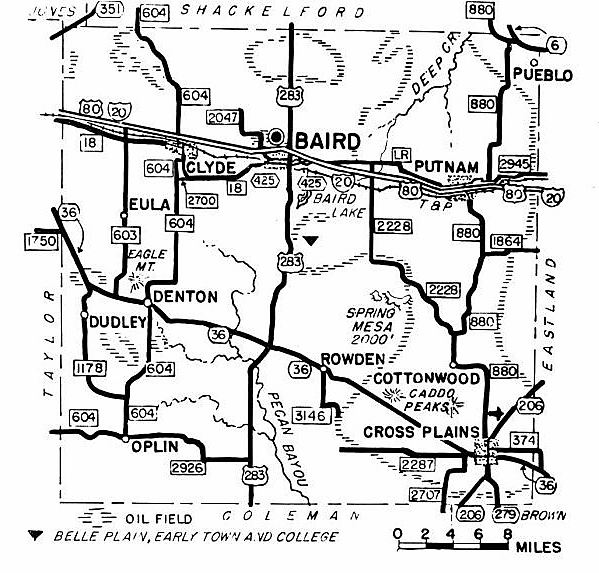
Map of Callahan County
 In 1877, the County was formally organized and the Callahan County Commissioners Court held an election in December to name the county seat. The town of Belle Plain was in the running and so was the temporary county seat, Callahan City; no doubt so named with hopes of becoming the permanent county seat. But the name advantage did little good – when the votes were counted, Callahan City lost its county seat status to Belle Plain. This sentenced Callahan City to a slow death. But as it turned out, Belle Plain only got a brief reprieve from that same fate.

Stations for the new Texas and Pacific Railway line were being built from Dallas to El Paso, with stops planned for Putnam, Baird, and Clyde – small settlements which quickly developed into towns. The railroad had completely bypassed Belle Plain six miles to the north. In January of 1883, an election resulted in Baird being made the new county seat. The effect of this outcome led to Belle Plain’s stone jail and most of the residences being moved to Baird, leaving only a handful of families in the dying town.
Texas farming ca 1890s
During period from the 1880s until the early 1900s, farming and ranching were the mainstays of the County. Corn, wheat, oats and cotton were the primary agriculture crops, while beef cattle accounted for the majority of the ranching, with some sheep being a commodity during the decade from 1880 to 1890. The population grew from 8,768 in 1900 to 12,973 in 1910. The pace of growth slowed after 1910 and started to decline by the mid-teens. The number of citizens in Callahan County fell to 11,844 by the time the Howards arrived in Cross Plains in 1919. The Texas Central Railroad had only come to Cross Plains seven years before the Howards bought a house and settled down. After the railway was built, the town became a major trading center for cotton and other crops.

The agriculture boom that Callahan County enjoyed had its price. Increased demand for land caused the price of real estate to rise. As a result of this, a lot of newcomers could not afford to buy land and this led to an increased number of tenant farmers. By 1920 nearly half the farmers (823 of 1,649) were tenants. The majority of these were sharecroppers who were permitted by landowners to farm the land and collected only a share of the harvest as payment for their efforts. While most sharecroppers in the state were African American, the reverse was true in Callahan County – all but one of the tenants was white.

Eventually, overgrazing, drought, soil erosion, and a shortage of potable water took its toll on ranching and farming in the county. This led to several conservation programs being established.

The decline in agriculture was somewhat offset by the discovery of oil in Callahan County and adjacent counties in 1923. A number of promising fields were found in Cross Plains, Pioneer, Cross Cut, and Blake, and by the late 1920s the oil business was booming bigtime. The oil and gas revenues generated from the production from the numerous wells in the area made it easier for some landowners to survive the economic slump of the 1930s and even made a few large landowners quite wealthy.

Like all Texas oil boom towns of that era, the oil fields in and around Callahan County were flooded with land speculators, oilmen, roughnecks, prospectors, panhandlers and fortune seekers. Those in turn drew in a seedier element of society, including card-sharks, prostitutes, bootleggers and drug dealers. Here, in a December 1930 letter to H.P. Lovecraft, Howard expresses his disdain for what his town and county became during the boom years:

You’re right about oil booms — they bring a lot of money into the country and take more out, as well as ruining the country for other purposes. This might offend men in the oil business, but it’s the truth that I’ve seen more young people sent to the Devil through the debauching effects of an oil boom than all the other reasons put together. I know; I was a kid in a boom town myself. The average child of ten or twelve who’s lived through a boom or so, knows more vileness and bestial sinfulness than a man of thirty should know — whether he — or she — practice what they know or not. Glamor and filth! That’s an oil boom. When I was a kid I worked in the tailoring business just as one terrific boom was dwindling out, and harlots used to give me dresses to be cleaned — sometimes they’d be in a mess from the wearer having been drunk and in the gutter. Beautiful silk and lace, delicate of texture and workmanship, but disgustingly soiled — such dresses always symbolized boom days and nights, to me — shimmering, tantalizing, alluring things, bright as dreams, but stained with nameless filth.

An oil well in Cisco ca. 1920s
Howard made other references to the ills brought about by an oil boom, but this one in particular stands out. While the county prospered when the oil was flowing, once it stopped everyone who came seeking their fortune moved on leaving the permanent residents of Callahan County to clean up the “nameless filth” they left behind.

With the onset of the Great Depression in the 1930s, many of the county's farmers, both tenants and owners experienced hard times and were heavily indebted. A combination of falling agricultural prices coupled with a boll weevil outbreak caused most banks to cease extending additional credit to the struggling farmers, forcing many of them off the land they owned or sharecropped.

By the end of 1936, the year Howard died, things were turning around for Callahan County and the rest of the nation as it slowly started climbing out of the depths of the Great Depression. While Howard had no interest in writing the history of his county, he did have a strong desire to write a great novel of his beloved Texas, a desire that went unfulfilled.


About Damon Sasser:

Damon Sasser has been a staple in Robert E. Howard fandom and REH Studies for four decades. He is the founder of REH: Two-Gun Raconteur website and journal. Sasser is a member of The Robert E. Howard United Press Association (REHupa) and has written countless articles for various fanzines and journals.

Sasser also has a nice Facebook Page for both the TGR website and journal. Be sure and check it out and "like" the page. You will not only get updates about articles posted on TGR but other tid-bits of great information on REH, H.P. Lovecraft, pulp zines, and what is circulating around the REH scholarly network.


Friday, May 29, 2015

Coming Soon . . .


Pre-orders are now being accepted for issue number 18 of The Definitive Robert E. Howard Journal.
This is an extremely limited edition of 150 copies, so don’t procrastinate if you want a copy.

The new issue will make its debut at Howard Days on June 12th. If you can’t make it to Cross Plains, you can pre-order it beginning today. Orders will ship in late June. Price per copy is $21.00, plus $4.00 for U.S. shipping and handling.

Click the title link to take you to TGR and order your copy!

Also . . .

Speaking of REH Days, as of this post it is exactly 14 days until fans and scholars gather in Cross Plain, TX, the home of Robert E. Howard, to discuss his work, carry on, have fun, read some poetry, drink a few beers, and just hang out. If you have never attended a Howard Days then by all means make every attempt to attend. I promise you, it will be well worth your time.

I hope to see all of you there this year!

This was recently Announced at the REH Days Website & Facebook Page . . .

STOP THE PRESSES! HOLD ONTO YOUR FEDORAS!

While the two-day schedule has remained pretty much the same, we do have one exciting change to mention. On Saturday afternoon the 2:30 "What's Up with REH?" panel has been scratched so that we may bring you an Interview with Brad and Jeff Howard, great grandsons of Dr. Howard's brother, David Terrell Howard! Well known Howard scholar and detective Patrice Louinet will be talking with Jeff and Brad about their fascinating family history. More surprises will ensue from this panel, so be sure to be there.

Of course, there will be other special neat things happening this year at Howard Days - someone unexpected always shows up! For so many of us, Howard Days is a great place to re-establish old friendships and make many new ones. There's plenty of room in Texas, so if you're still on the fence, come to Cross Plains and see why Howard Days is The Best Two Days in Howard Fandom!

Also, the guests for this year have already been announced on the various Facebook pages and at the Robert E. Howard Days website:

HOWARD DAYS 2015 GUEST OF HONOR
Mark Schultz
MARK SCHULTZ is well-known as the illustrator for the first Wandering Star pure REH text Conan edition, The Coming of Conan. His paintings, full-page drawings, chapter headings and spot illustrations fill this volume with a clean, energetic and stylistic imagery. Other Howard work that Mark has done includes the covers to Worms of the Earth (Cross Plains Comics), The Colossal Conan (Dark Horse Comics) and the Adventures in Science Fantasy volume for the REHF Press. HE will also be painting a cover for the upcoming Conan role-playing game from Modiphius. One of Mark’s designs is used on the REH Museum t-shirt. And, as it turns out, his very first professional comics work was inking the pencils of Val Semeik’s Kull story in the Savage Sword of Conan #132. Mark will also be doing the artwork for the special souvenir postal cancellation stamp for Howard Days this year.

If you intend to go this year, be sure and book your hotel asap, there are not that many hotel rooms left in the area. I hope to see you all there. Cheers!


Sunday, May 3, 2015

Guest Posting at TGR . . .

REH: Two-Gun Raconteur was kind enough to let me guest post on their site. 


The article is titled The Kid, Two-Gun, and History. It's about the influence of Billy the Kid, more specifically Walter Noble Burns' book The Saga of Billy the Kid, on Robert E. Howard, his writing, and the the direction he took toward western lore and stories the last few years of his life.  When you get a moment go check out the article. 

Also, this site is one of the best Robert E. Howard sites on the internet, so if you have several hours to spend, the site is well worth the time invested. I've spent many hours reading the site's archives. And I can assure you that was time well spent. Cheers!


Monday, August 13, 2012

A Sunday Afternoon with an REH Website

I spent yesterday afternoon perusing one of my favorite REH blogs on the internet: REH: Two-Gun Raconteur. I jumped to the sites archives, beginning January 2007 and read all the way through to the current post, August 1st 2012.

If you are new to Howard studies, this site is a must. Even if you are old to Howard studies this site is a must. Just about every possible topic, announcement, new book or fanzine about Howard, etc. is mentioned or discussed on this site. The site also contains links to REH Publishers, REH Scholar Resources, Other REH Websites (which I am proud to say that the old URL for On an Underwood #5 is listed, hopefully the new URL will be listed soon.), and other links such as Friends of TGR, etc. are present on the site.

Having spent the afternoon reviewing all the posts, there were a few that really grabbed my attention. These are certainly worth mentioning:

Feminism and The Women in Robert E. Howard's Fiction—Part 1

This article, written by Barbara Barrett and Amy Kerr, is about how society over the centuries has viewed women, their roles, and how that differed in Howard's stories. This article has three parts and every part is a great read.

Yellow Jacket by Rob Roehm


This article is a brief but wonderful history about the Howard Payne College student newspaper and several stories authored by Howard. These stories were previously "lost" until they showed up in Vol. 4, #3 Fall 2010 REH Foundation Newsletter. Read this article by Rob and you'll get a nice history of REH's beginnings as a published writer.


Psycho Thomas Ellison Makes a Mess by Damon C. Sasser.

Along with a few others—here and here—the "Psycho" article is an attempt to respond to faulty information/posts by others who may not have their facts straight about Robert E. Howard. The faulty articles are worth reading as well, if for no other reasons than the responses given by core Howard fans who actually know what they're talking about. Misinformation about Howard, and downright lies still circulate, it's these posts and hopefully future ones that will aid in correcting the errors, at least via the internet.

Other items of note: Brian Leno offers some nice posts on Howard's favorite books and films, along with those Howard disliked. Leno's articles are well written and informative and well worth a thorough read.

Almuric—One Wild, Wild Planet by Keith Taylor

This article is an expositional treatise about Howard's unique work titled Almuric. The article is well written and also touches on some of the influences of Howard's within the story (e.g. Edgar Rice Burroughs' Barsoom.). Taylor adds great insight into the story and a bit of the historicity of ill-fitted Earth men getting a new start in an alien world since Almuric. This piece is well worth reading. In fact, I'll go so far as to to say that if you only read a few things from the "Two-Gun" website, certainly read this one.

A Mysterious People by Keith Taylor

Another article by Keith Taylor reveals REH's love for history, various peoples, lands, civilizations, times, etc. This article dicusses all these things and more. Taylor brings to bear correspondence between H. P. Lovecraft and Robert E. Howard regarding the Etruscans (Tuscans), their Roman origins, and how they play a role in Howard's research and writing.  The historical details in this article are first rate. Here is another "must-read" at Two-Gun by Keith Taylor.

I could mention a lot more but I trust that most of you who read this post will certainly take the time, if you already haven't, to read the posts at REH: Two-Gun Raconteur. Between Sasser's informative articles about new publications, new blog sites, etc., Rob Roehm's excellent "time capsules" on Howard's history, from the smallest piece of history to the more popular history, Keith Taylor's historical expositions, Brian Leno's work on Howard's influences and favorite authors/movies, and others, there's enough on this great blog to keep you busy on a hot Sunday afternoon. Cheers!